
_svg.png)
Setting Up A Company In Dubai: 6 Myths That Will Hold You Back in 2026
Updated: Jun 16
The "tax-free" paradise you were promised no longer exists in the way you imagine; clinging to that outdated vision is the fastest way to compromise your global expansion strategy. You've likely heard that Dubai remains a land of mandatory local partners and hidden fees, leaving you hesitant to commit capital while fearing a loss of operational control. These common business setup myths Dubai generates can paralyse even the most ambitious UK decision-makers. It's time to replace anecdotes with the sharp, strategic reality of 2026.
We'll dismantle the misconceptions holding you back and provide a clear, authoritative roadmap for residency and setup. You'll discover how to navigate the 9% corporate tax environment on profits exceeding £80,000 and leverage Small Business Relief for revenues under £640,000. We're moving beyond simple registration to focus on sophisticated wealth structuring and operational excellence from day one. This guide ensures your transition to the Emirates is a calculated move toward asset protection rather than a leap into the unknown. It's time to eliminate the barriers between your current operations and your future growth.
Key Takeaways
Secure total autonomy over your enterprise by leveraging the latest regulations that permit 100% foreign ownership for UK investors.
Dismantle the business setup myths Dubai presents to clarify your obligations under the 2026 corporate tax regime and Small Business Relief thresholds.
Protect your expansion timeline by understanding the strategic difference between obtaining a trade licence and activating a fully functional corporate bank account.
Transition from a "licence-only" mindset to a robust operational model that integrates wealth structuring and asset protection from the outset.
Table of Contents
Myth 1: You Must Relinquish 51% Ownership to a Local Partner
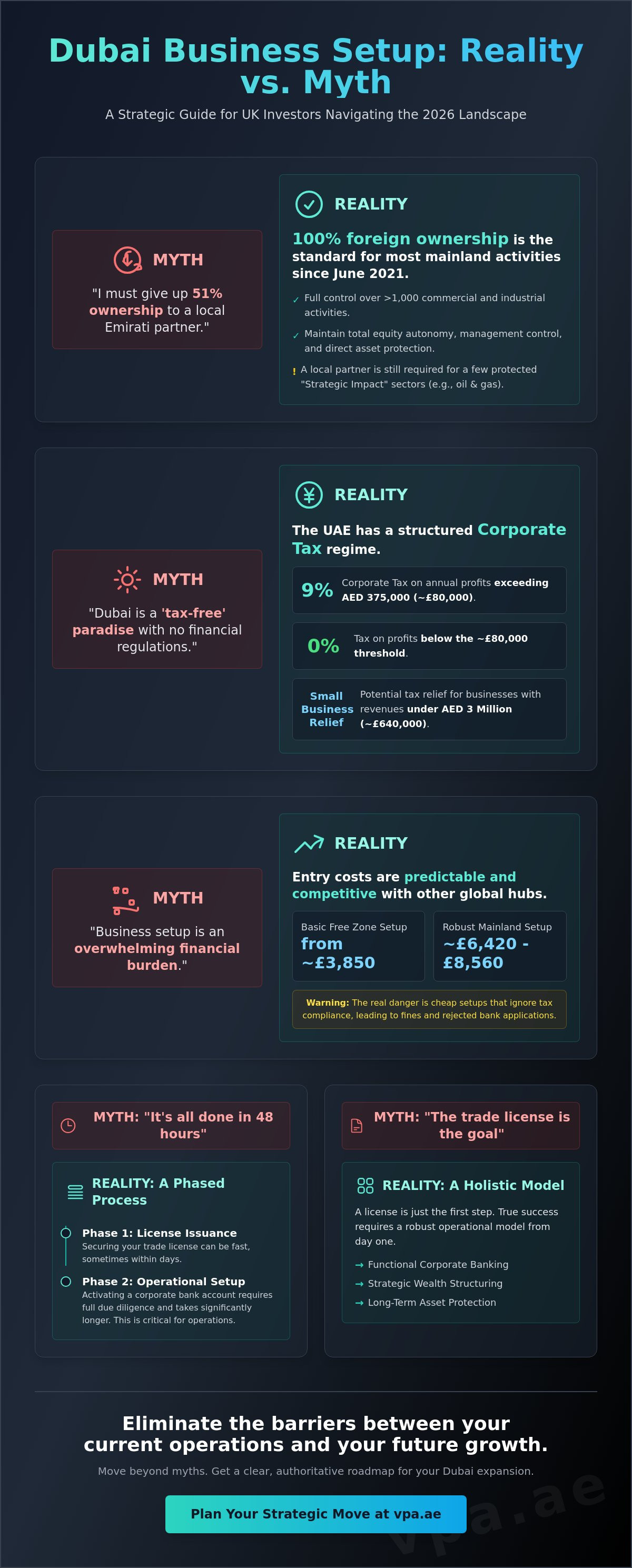
The era of mandatory local sponsorship ended on June 1, 2021. If you're still hearing that you need a local partner to hold 51% of your shares, you're listening to one of the most persistent business setup myths Dubai has to offer. Federal Decree-Law No. 26 of 2020 fundamentally altered the corporate landscape by allowing foreign investors to maintain full ownership of businesses in Dubai across more than 1,000 commercial and industrial activities. This wasn't just a minor policy adjustment; it was a total dismantling of the barriers that once kept UK entrepreneurs from fully controlling their UAE enterprises.
UK decision-makers must distinguish between license categories to understand their structural requirements. Commercial and Industrial licenses, which previously required a local majority shareholder, now allow for 100% foreign equity. Professional licenses, covering consultancy and service-based firms, have historically permitted full ownership but required a Local Service Agent (LSA). In 2026, the LSA remains a purely administrative role. They facilitate government relations and permit processing without holding any equity or management rights over your firm. You maintain absolute authority over your board, your profit distribution, and your exit strategy.
Key structural shifts since the 2021 reform include:
Equity Autonomy: Removal of the 51% Emirati shareholding requirement for the vast majority of mainland activities.
Management Control: Full authority over the appointment of directors and executive leadership.
Asset Protection: Direct ownership of physical assets and intellectual property without third-party interference.
Streamlined Governance: Simplified liquidation and share transfer processes that mirror international standards.
Mainland vs. Free Zone Ownership Structures
Mainland companies now compete aggressively with Free Zones for foreign capital. While Free Zones offer sector-specific hubs and tailored regulations, a Mainland setup provides the freedom to trade directly within the UAE market and bid for lucrative national contracts. You no longer have to choose between market access and total control. This shift has levelled the playing field, making Mainland structures a primary choice for scalable enterprise. Strategic planning ensures you select the jurisdiction that aligns with your specific operational goals rather than settling for a Free Zone simply to avoid a partner you don't actually need.
The Reality of Strategic Sectors
Total ownership is the standard, yet certain "Strategic Impact" sectors remain protected. If your expansion involves oil and gas, utilities, or specific transport sectors, a local partnership is likely still required. Navigating these exceptions requires precise management consulting to ensure your structure aligns with Federal Decree-Law No. 20 of 2025. Identifying these boundaries early prevents costly restructuring down the line. For the average UK consultancy or trading firm, however, the 51% rule is a ghost of the past that should no longer dictate your entry strategy.
Myth 2: Dubai Business Setup is an Overwhelming Financial Burden
The perception that entering the UAE market requires a bottomless pit of capital is one of the most damaging business setup myths Dubai perpetuates. While high-tier consulting and premium office spaces carry a price tag, the actual entry costs are often lower than comparable setups in other major international business hubs or Singapore. In 2026, the barrier to entry is more about strategic allocation than raw expenditure. A basic Free Zone setup can start as low as £3,850, while a robust Mainland presence typically requires an initial investment of roughly £6,420 to £8,560. These figures are predictable and manageable for any serious UK enterprise looking to scale.
The real financial danger lies in "budget" providers who offer rock-bottom prices but ignore the regulatory framework. While they might secure a license, they often fail to prepare you for the UAE's corporate tax law, which mandates compliance even for firms below the 9% threshold. Choosing the cheapest path often results in expensive corrections, fines for late tax registration, and rejected bank applications. True operational excellence requires viewing these costs as a strategic investment rather than a mere administrative hurdle. For those seeking a tailored entry plan, engaging in strategic planning with Ventureprise Acquisitions ensures your capital is deployed where it generates the highest return.
Paid-Up Capital Requirements
In 2026, the requirement to deposit a large sum of "paid-up" capital before starting operations is largely a relic. Most jurisdictions only require you to declare an "authorised" capital amount on your license. While some specific Free Zones or high-impact sectors still mandate proof of capital, the majority of professional and commercial setups do not. This liquidity-friendly approach allows you to channel your funds directly into growth and infrastructure rather than letting them sit idle in a corporate account. You maintain control over your cash flow from the moment of incorporation.
Hidden Costs vs. Strategic Investment
Success in Dubai requires looking beyond the trade license. You must account for the full ecosystem of operational costs to avoid surprises. These include:
Visa Processing: Budget approximately £640 to £1,070 per person for medical fitness tests, Emirates ID, and stamping.
Establishment Cards: Necessary for visa quotas, costing between £215 and £430.
Office Solutions: While flexi-desks are cost-effective at roughly £1,000 per year, a physical headquarters is often required for specific banking approvals.
Compliance Tech: Mandatory e-invoicing and AI-based monitoring systems starting in July 2026.
Treating these as "hidden" costs is a mistake; they are the foundational components of a legitimate, scalable business. A well-structured setup ensures your wealth is protected and your operational rhythm is uninterrupted from day one. By planning for these figures upfront, you transform a perceived burden into a calculated step toward global dominance.
Myth 3: Company Formation and Banking Can Be Completed in 48 Hours
Don't be seduced by the marketing promise of a 48-hour setup. While it's technically possible to receive a digital trade license in two days within specific Free Zones, this is merely the first step of a multi-stage marathon. A piece of paper does not equal an operational business. You cannot hire staff, lease premises, or invoice clients without a corporate bank account and residency visas. Clinging to the "instant" narrative is one of the most dangerous business setup myths Dubai promoters sell, as it leaves founders unprepared for the inevitable operational lag.
Corporate banking is the true gatekeeper of the UAE market. Since the introduction of more rigorous AML (Anti-Money Laundering) and KYC (Know Your Customer) protocols, the timeline for account opening has shifted from days to weeks. The UAE's reformed foreign ownership rules have led to a surge in new registrations, prompting Tier 1 banks to be even more selective with their clientele. Expect a realistic window of three to five weeks for a fully functional banking facility. Rushing this process without a strategic roadmap usually results in rejected applications and "blacklisting" by major financial institutions.
The Banking Bottleneck and How to Bypass It
UK entrepreneurs often face heightened scrutiny due to complex international tax reporting requirements. Traditional Tier 1 institutions like Emirates NBD or Mashreq require substantial documentation and, frequently, a physical office presence. Digital banks like Wio or Zand offer a faster alternative for startups, though they may lack the sophisticated trade finance tools required by larger enterprises. Leveraging "introducer" status through a professional consultancy can bypass the generic application queue, placing your file directly in front of decision-makers who understand UK corporate structures and source of wealth documentation.
Residency and the Golden Visa Integration
Your business setup must align perfectly with your residency goals. For high-net-worth founders, the 10-year Golden Visa provides unparalleled stability, but it requires a specific sequence of medical checks, biometrics, and Emirates ID issuance. This process typically takes 7 to 14 working days after your entry permit is issued. Ventureprise Acquisitions streamlines this end-to-end residency path, ensuring your visa status, corporate structure, and banking applications move in a synchronised rhythm. We eliminate the friction of dealing with multiple government departments, allowing you to focus on your strategic market entry from day one.
Myth 4: Dubai Remains a "Tax-Free" Wild West for Businesses
The belief that Dubai is a lawless fiscal vacuum is perhaps the most outdated of all business setup myths Dubai attracts. In 2026, the UAE has fully integrated into the global financial mainstream. The introduction of a federal corporate tax at a standard rate of 9% on taxable income exceeding £80,000 marks the end of the "wild west" era. While this remains one of the most competitive rates globally, it demands a level of fiscal discipline that many UK founders overlook. You're no longer just running a "tax-free" entity; you're managing a sophisticated international corporation subject to OECD-aligned standards.
Qualifying Free Zone Persons can still enjoy a 0% rate on qualifying income, but this isn't a default setting. It requires strict adherence to Economic Substance Regulations (ESR). You must demonstrate that your core income-generating activities happen within the UAE. Shell companies with no physical presence or local employees are increasingly vulnerable to penalties. We focus on structuring for global tax efficiency, ensuring your UAE operations complement your UK tax obligations rather than creating a compliance nightmare. Success here is about strategic positioning, not just local avoidance.
Corporate Governance and Compliance Standards
Operational excellence in 2026 requires more than just a trade license. Audited financial statements are now a standard requirement for many jurisdictions and almost all Tier 1 banking relationships. You must also navigate a 5% VAT regime if your taxable supplies exceed the £80,000 threshold. With the e-invoicing mandate beginning in July 2026, manual record-keeping is a recipe for failure. Our management consulting services provide the strategic oversight needed to transition from a startup mindset to a fully compliant corporate structure.
Private Wealth Structuring and Asset Protection
Beyond corporate taxes, sophisticated founders are prioritising asset protection through Dubai Foundations. These legal entities allow you to ringfence global assets, providing a robust alternative to traditional trusts. By leveraging the Common Law frameworks of the DIFC or ADGM, UK founders can secure their legacy under a legal system that feels familiar and predictable. This is about more than just avoiding tax; it's about building a fortress around your wealth—a strategy that often extends to property diversification in locations like Melbourne with the help of Your Australian Property Buyers Agents. Succession planning is no longer an afterthought. It's a fundamental component of your Dubai entry strategy, ensuring your enterprise survives and thrives across generations.
Myth 5: Business Setup is Only About the Trade License
Treating a trade license as a completed business is one of the most pervasive business setup myths Dubai presents to the uninformed. A license is merely a permission slip to exist. Many founders fall into the trap of "license-only" providers who leave you with a "ghost company"—a valid registration but no operational pulse. Without a functional bank account and residency visa, your enterprise is dead on arrival. Success requires a transition to comprehensive management consulting; similarly, for those expanding into India, Krystal7 Consultants provides the company registration and legal compliance support needed to ensure a functional corporate presence.
The paper you receive from a Free Zone or the Department of Economy and Tourism (DET) is just the starting block. True operational excellence involves aligning your strategic planning with the realities of the 2026 market. This includes navigating the e-invoicing mandate and ensuring your wealth is protected through sophisticated structuring. We focus on the entire lifecycle of your expansion, moving beyond the administrative paperwork to build a business that is ready to scale and compete from the moment your digital certificate is issued.
Operational Infrastructure and HR Strategy
Scaling from a solo founder to a regional hub requires more than just ambition. You must navigate a highly competitive talent market where attracting top-tier professionals requires a clear HR strategy and compliant employment contracts. Your IT infrastructure must also meet stringent UAE data privacy laws, which have become increasingly rigorous. Implementing these systems early prevents the friction that typically slows down UK firms attempting to "figure it out" as they go. We help you build a resilient foundation that supports rapid growth without compromising regulatory safety.
The Strategic Advantage of London-Based Advisory
Working with consultants who understand both the UK corporate landscape and UAE regulations provides an unmatched advantage. We bridge the gap between British business culture and the specific nuances of the Dubai market, ensuring nothing is lost in translation. This dual perspective allows for a seamless transition, protecting your global assets while positioning you for maximum growth in the Emirates. Don't settle for a provider that only understands half of your story. Secure your strategic consultation with Ventureprise Acquisitions to ensure your Dubai entry is a calculated move toward permanent success.
Master the Strategic Reality of Dubai Expansion
Dismantling the outdated business setup myths Dubai often generates is the first step toward a successful international footprint. We've established that 100% ownership is now the standard for UK investors, and the 9% corporate tax regime on profits over £80,000 represents a shift toward global transparency rather than a barrier to entry. Your focus must now move beyond simply acquiring a trade license to building a robust operational foundation that includes secure banking and compliant tax structures.
Realising your ambitions in the UAE requires more than administrative support; it demands a partner that understands the specific pressures of the UK-to-Dubai transition. We provide bespoke private client wealth structuring and specialised residency facilitation to ensure your move is both seamless and strategically sound. Through expert-led strategic management consulting, we remove the professional barriers that hold others back, allowing you to focus on high-value outcomes from day one.
Begin Your Strategic Dubai Expansion with Ventureprise Acquisitions and transform your vision into a high-value reality. The future of your enterprise starts with a single, calculated decision to lead. We're ready to accelerate your progress.
Frequently Asked Questions
Do I really need a local partner to start a business in Dubai in 2026?
You don't need a local partner for the vast majority of commercial and industrial activities. Since the 2021 regulatory overhaul, foreign investors can maintain 100% ownership of mainland companies. While strategic sectors like oil and gas or defense still require local partnership, the 51% shareholding requirement has been abolished for most UK firms. This shift is one of the most persistent business setup myths Dubai continues to face.
How long does the average corporate bank account opening take for UK citizens?
Expect the corporate bank account opening process to take between three and five weeks. While your trade license might arrive in as little as 48 hours, banks conduct rigorous KYC and AML checks on UK applicants. Providing clear documentation regarding your source of wealth and professional background is essential to avoiding delays. Digital banking platforms often offer a faster entry point than traditional Tier 1 institutions for startups.
What are the actual tax implications for a Dubai company with UK-based directors?
Your Dubai entity is subject to a 9% corporate tax on profits exceeding £80,000. However, UK-based directors must be mindful of "Management and Control" rules. If HMRC determines the company is effectively managed from the UK, it could be liable for UK Corporation Tax. Strategic wealth structuring is necessary to ensure your setup remains tax-efficient across both jurisdictions and avoids unexpected liabilities at home.
Is a physical office mandatory for all Free Zone companies?
A physical address is mandatory for all companies, though "flexi-desk" or "co-working" solutions satisfy the requirement for many Free Zones. You cannot obtain a trade license or process residency visas without a registered office space. For those seeking Tier 1 banking, a dedicated physical office often provides a significant advantage during the application process by demonstrating operational substance and a genuine commitment to the region.
What is the difference between a Mainland and a Free Zone license?
Mainland licenses allow you to trade anywhere within the UAE and bid for government contracts without restriction. Free Zone licenses are geographically confined to their specific hub but offer industry-specialised infrastructure and streamlined customs for international trade. Your choice depends on whether your primary market is the local UAE economy or global commerce. Both options now permit 100% foreign ownership for the majority of sectors.
Can I get a Golden Visa through my new Dubai business setup?
You can obtain a 10-year Golden Visa if your business investment meets specific capital thresholds, typically around £430,000. This residency status provides long-term stability and doesn't require a local sponsor for your visa. Aligning your company formation with Golden Visa requirements from the start ensures a smooth transition for high-net-worth founders and their families, securing your legacy in the Emirates.
What are the hidden costs of Dubai company formation I should budget for?
Budget for essential operational costs beyond the initial license fee, such as establishment cards, medical fitness tests, and Emirates ID processing. These typically range from £640 to £1,070 per person. You must also account for mandatory e-invoicing software and potential VAT registration fees. Planning for these upfront ensures a smooth launch, avoiding the common business setup myths Dubai generates regarding "cheap" entry points that ignore compliance.
How does the UAE corporate tax affect small to medium-sized enterprises?
Small to medium-sized enterprises benefit from a 0% tax rate on profits up to £80,000. Additionally, the Small Business Relief scheme allows firms with annual revenue below £640,000 to be treated as having no taxable income for periods up to 2026. This structure ensures that the 9% corporate tax only impacts businesses that have achieved significant commercial scale, allowing smaller UK expansions to reinvest their profits for rapid growth.



Comments