

ADGM foundations for asset ownership and wealth preservation
ADGM foundations for wealth management can hold assets through a separate legal entity with no shareholders, but that structure alone doesn’t secure a particular tax outcome. A Family Foundation may apply under Article 17 of Federal Decree-Law No. 47 of 2022 to be treated as an Unincorporated Partnership for UAE corporate tax. For UK-resident founders, this doesn’t automatically prevent UK tax attribution.
It’s reasonable to expect a wealth structure to protect assets while preserving influence over how they’re managed and passed on. The key is to distinguish the foundation’s legal ownership, the council’s powers and beneficiaries’ entitlements from the tax treatment that may apply in the UAE and the UK.
This article explains how an ADGM foundation holds assets, how its charter can define beneficiary rights, and how council and guardian roles support its governance. It also considers the UAE corporate-tax route and UK rules that may affect founders, helping you assess the structure as part of an integrated succession and wealth-planning decision.
Table of Contents
ADGM foundations for asset ownership and beneficiary entitlements
An ADGM foundation holds assets in its own name, separating legal ownership from the founder’s personal estate. Its charter and rules can define how assets are managed and how beneficiaries receive entitlements.
Asset Ownership and Succession
A foundation is a separate legal entity that can hold assets for stated purposes or beneficiaries. This can matter when a founder wants a defined succession framework for family wealth, corporate interests or real estate across generations.
The council administers the foundation’s assets under its governing documents; beneficiaries do not own each asset directly. A family office, for example, might use this structure to coordinate investments and succession planning. This separation can support continuity, but it is not an absolute shield from creditor claims or challenges to asset transfers.
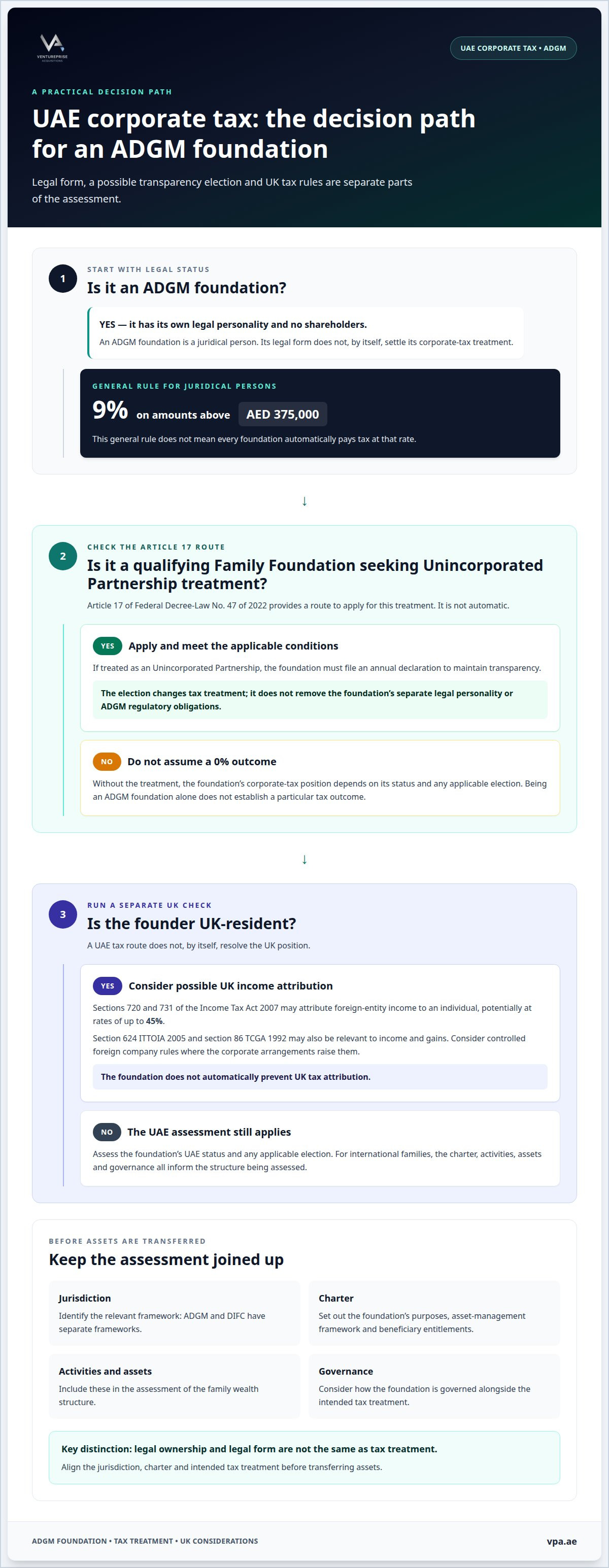
For UK-resident founders, the structure does not remove UK tax analysis. Sections 720 and 731 of the Income Tax Act 2007 may attribute foreign entity income to an individual, potentially at rates of up to 45%. Section 624 ITTOIA 2005 and section 86 TCGA 1992 may also be relevant to income and gains. Consider controlled foreign company rules where the corporate arrangements raise them.
Eligibility and Establishment
Establishing a foundation involves preparing a charter that complies with the Foundations Regulations 2017, lodging it with the ADGM Registration Authority and appointing a licensed Company Service Provider as registered agent. The name must end in “Foundation”. These requirements shape the application and provide its formal governance framework.
The charter is the central establishment document. It sets out the foundation’s purposes and the framework for managing assets and beneficiary entitlements. Before incorporation, the founder should align its provisions with the intended succession plan. Eligibility depends on meeting ADGM’s establishment requirements, not on a stated minimum personal wealth threshold.
Budget for an incorporation fee and an annual renewal fee. Applicable charges and ongoing costs depend on the foundation’s arrangements and service providers. The charter can provide a framework for how assets are administered. Include registered-office arrangements and capital planning in the setup, particularly if family-office interests or real estate are involved.
Privacy and succession benefits come from having a distinct entity and documented governance, not from guaranteed secrecy or immunity. The ADGM framework balances confidentiality with transparency. Consider creditor exposure, challenges to transfers and UK tax attribution together when planning asset protection.
Does a DIFC or ADGM foundation pay UAE corporate tax?
An ADGM foundation has its own legal personality and no shareholders. Established under the Foundations Regulations 2017, it is a juridical person, so its corporate tax treatment depends on its status and any applicable election. The DIFC has a separate framework: DIFC Law No. 3 of 2018 was enacted on 14 March 2018.
For juridical persons, the UAE corporate tax rate is 9% on amounts above AED 375,000. That general rule does not mean every foundation automatically pays tax at that rate. Article 17 of Federal Decree-Law No. 47 of 2022 provides a route for a Family Foundation to apply for treatment as an Unincorporated Partnership.
This treatment is not automatic: a qualifying foundation must apply and meet the applicable conditions. If treated as an Unincorporated Partnership, it must file an annual declaration to maintain transparency. The election affects tax treatment; it does not remove the foundation’s separate legal personality or its regulatory obligations under ADGM’s framework.
The FTA issued its Corporate Tax Guide on Family Foundations in 2025 and its Public Clarification on corporate tax treatment of family wealth management structures on 19 September 2025. These materials address how family foundations and related holding structures are considered. They make the distinction between legal form and tax treatment central to planning.
For international families, the foundation’s charter, activities, assets and governance all inform the structure being assessed. A service provider can help coordinate the foundation’s establishment and administration, but tax treatment rests on the applicable rules and the foundation’s circumstances. A 0% outcome should not be assumed simply because the entity is an ADGM foundation.
Align the jurisdiction, charter and intended tax treatment before transferring assets. A focused private-client wealth structuring discussion can help connect those decisions with wider succession objectives.
Foundation councils, guardians and beneficiaries
A foundation’s governing documents can set out how it is managed and how beneficiaries may benefit. The roles are distinct: the council administers the structure, a guardian can provide oversight, and beneficiaries receive entitlements set out in the governing documents. For families planning across generations, clear boundaries help turn intentions into a workable framework.
The council administers the foundation’s affairs under its charter and regulations. Its composition should reflect the expertise and continuity needed to manage the assets, such as corporate interests or family investments. ADGM foundations must notify the regulator of a change in council composition. Governance is therefore an ongoing responsibility, not just an incorporation decision.
A guardian can provide an additional layer of oversight within the foundation’s governance arrangements. The charter should define the role’s scope and how it relates to the council’s authority. For example, a founder might want a guardian to review whether a proposed distribution follows the foundation’s stated purpose. Clear drafting helps avoid uncertainty between those who administer assets and those who oversee decisions.
Beneficiary entitlements depend on the charter and any governing rules, rather than direct ownership of each underlying asset. A family might specify when a beneficiary can receive support or how the council should consider requests. These terms can support private succession planning while keeping foundation assets distinct from beneficiaries’ personal estates.
A foundation established in Abu Dhabi must also meet transparency and regulatory obligations. The ADGM regime balances client confidentiality with transparency, so privacy should not be mistaken for complete secrecy. Before transferring assets, founders should align the council’s powers, guardian oversight and beneficiary provisions. This is especially important when a family office manages wealth intended to remain coherent across generations.
Foundations as a wealth management and preservation structure
ADGM introduced foundations as a specialized legal structure for international wealth management and preservation. For families considering ADGM foundations for wealth management, the value lies in coordinating ownership, governance and succession through one distinct entity, rather than treating each asset as a separate planning decision. A family with operating companies, investments and property can use this framework to organise those interests across generations from an internationally recognized financial centre.
The structure can support global arrangements involving holding companies, special purpose vehicles and family offices. For example, a foundation may own a holding company, which in turn holds investments or other assets. These vehicles can help organise decision-making, but they do not replace an investment strategy or effective governance.
ADGM provides both Foundations Regulations and Trust Laws as robust frameworks for structuring international and cross-border affairs. A foundation and a trust are distinct legal structures, so their ownership and administration arrangements should match the family’s objectives. ADGM also allows foundations to migrate to and from other jurisdictions, which may matter as family plans or connections change.
The regime offers access to the UAE’s extensive double tax treaty network. Consider that access alongside the foundation’s activities, ownership and cross-border tax position; it does not determine the tax outcome on its own. For UK-connected families, the UK treatment of the founder, assets and beneficiaries must also be part of the plan. Planning with ADGM foundations for wealth management should account for obligations in every relevant jurisdiction.
Start with the purpose: decide which assets need coordinated ownership, who should govern them, and how succession should operate. Then compare a foundation with trusts and corporate vehicles against those goals. An independent review can expose gaps before assets move. Discuss your wealth-structuring objectives with Ventureprise Acquisitions to develop a plan connecting governance, investment and succession.
Ventureprise Acquisitions: Setting Up A Company In Dubai: 6 Myths That Will Hold You Back
Ventureprise Acquisitions helps entrepreneurs connect private-client structuring with wider business and succession objectives. If an ADGM foundation forms part of a broader family or corporate plan, its Private Clients Foundations amd Trustss offering and Strategic Planning service can help bring those decisions into a coherent structure.
For readers also considering a commercial presence in Dubai, Company Formation addresses that separate need. The guide Setting Up A Company In Dubai: 6 Myths That Will Hold You Back offers context for assessing common assumptions before making formation decisions. The right next step depends on whether your priority is family wealth structuring, business establishment, or aligning both.
Contact Ventureprise Acquisitions or visit vpa.ae to discuss your objectives.
Turn your wealth objectives into a considered plan
The next decision is not simply whether to establish a foundation. It is how to make your chosen structure support your family’s priorities while keeping governance and cross-border considerations aligned. Start by defining what the arrangement should achieve, how decisions should be made and what may need to change as circumstances evolve.
That gives discussions about ADGM foundations for wealth management a practical direction. Instead of treating each choice in isolation, consider how it fits the wider picture and where unresolved questions could affect implementation. Ventureprise Acquisitions can help you shape those priorities into a coherent plan for the next steps.
Contact Ventureprise Acquisitions to discuss your objectives and move forward with greater clarity.
Frequently Asked Questions
Can I keep control of the foundation and still get the tax benefit?
Keeping influence does not, by itself, establish eligibility for UAE tax transparency. Article 17 of Federal Decree-Law No. 47 of 2022 provides a route for a Family Foundation to apply for treatment as an Unincorporated Partnership, subject to applicable conditions. The governance design and the application must therefore be considered together. For UK-resident founders, income attribution rules may still apply independently of the UAE treatment.
Does a foundation protect my wealth from UK inheritance tax?
No, an ADGM foundation does not automatically remove UK inheritance tax exposure. The UK relevant property regime can impose ten-year anniversary charges on a foundation’s foreign assets when its founder is a long-term UK resident. Section 43 of the Inheritance Tax Act 1984 defines a settlement for inheritance tax purposes. Consider the founder’s UK residence position and the assets involved when assessing the structure.
What is the difference between a foundation and a trust?
A foundation is a legal entity with its own legal personality and no shareholders; a trust is a different legal arrangement. ADGM’s Foundations Regulations and Trust Laws provide distinct frameworks for asset planning. For example, a family deciding how to hold investments should compare who legally owns them, who administers them and how beneficiaries benefit under each structure. These differences shape governance and succession planning.
What is an ADGM foundation and how can it be used for wealth management?
An ADGM foundation is a separate legal entity established under the Foundations Regulations 2017. It can hold assets and support family succession, wealth management and corporate structuring. For example, a founder may use it to organise ownership of a family business and set out how beneficiaries may benefit. Its usefulness depends on how its purpose, governance and assets fit the family’s wider plans.
What roles do the founder, council members, guardian and beneficiaries have in an ADGM foundation?
The founder establishes the foundation and sets its purpose through its governing documents. Council members administer its affairs within that framework, while a guardian provides the oversight assigned to the role. Beneficiaries receive entitlements defined by the documents, rather than automatically owning foundation assets. For example, a charter can guide how the council considers a beneficiary’s request and define any guardian oversight separately.
How are ADGM foundations taxed in the UAE and in the UK?
In the UAE, a Family Foundation may apply for Unincorporated Partnership treatment under Article 17 of Federal Decree-Law No. 47 of 2022. Otherwise, corporate tax treatment depends on the applicable rules and status. In the UK, sections 720 and 731 of the Income Tax Act 2007 may attribute foreign entity income to a UK-resident individual; other income, gains and inheritance tax rules may also matter.



Comments