

Dubai tech company setup for UK entrepreneurs
Dubai tech company setup for UK entrepreneurs can take place through a free zone or mainland structure, while an offshore company serves a different purpose. UAE mainland and free-zone companies can have 100% foreign ownership. The right structure depends on how your technology business will operate, who it needs to serve and where it plans to grow.
Dubai’s appeal goes beyond company registration. Its technology-focused business environment gives UK founders a route into a regionally connected market. But choosing a structure before mapping your customers and activities can create unnecessary friction. This guide explains the differences between free-zone, mainland and offshore companies, outlines ownership rules and explores why Dubai attracts tech entrepreneurs. You’ll have a clearer basis for deciding which setup fits your plans.
Table of Contents
Step 2: Mainland or Free Zone?
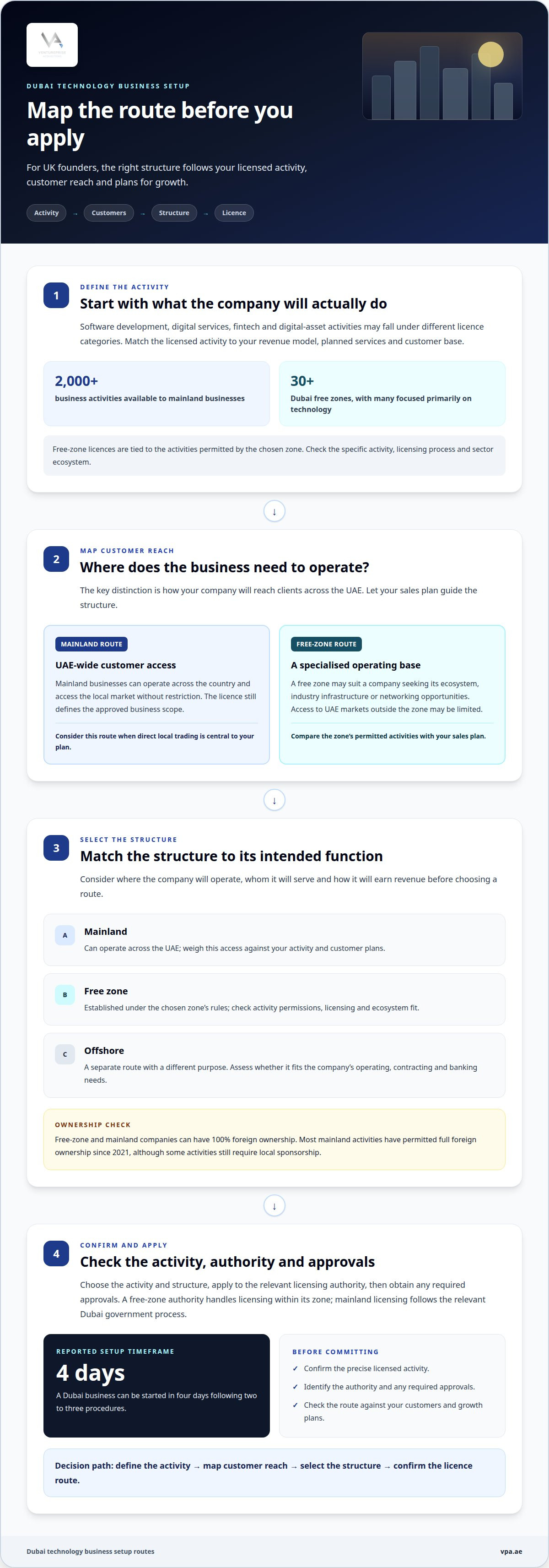
Choose a structure based on your customers, licensed activities and growth plans. For UK founders, the key distinction is how the business will reach clients across the UAE.
Business Activities and Licensing
Start by defining what the technology company will actually do: software development, digital services, fintech or digital-asset activities may require different licence categories. Dubai mainland businesses can choose from over 2,000 business activities, while free-zone licensing is tied to the relevant zone’s permitted activities. Match the activity to your revenue model, planned services and customer base before selecting a structure.
The setup process starts with choosing an activity and structure, then applying to the relevant licensing authority and obtaining any required approvals. A Dubai business can be started in four days following two to three procedures. The authority depends on the route: a free-zone authority handles licensing in its zone, while mainland licensing follows the relevant Dubai government process.
Mainland Market Access
A free zone may be a better fit for a company focused on its zone’s ecosystem, industry infrastructure or networking opportunities. However, free-zone companies may have limited access to markets outside their zone in the UAE. Compare the route with your sales plan: direct local trading points towards mainland access, while a specialised operating base may make a technology-focused free zone a stronger fit.
Technology Business Setup Routes
Dubai has over 30 free zones primarily focused on technology, but no single zone is best for every company. Choose by checking whether its permitted activity, licensing process and sector ecosystem fit your business model. Free zones can offer streamlined regulatory processes, alongside industry-specific infrastructure and networking opportunities.
For fintech or digital-asset businesses, identify the precise activity and establish which approvals apply before committing to a route. A technology label alone does not determine the licence. Mainland may favour broad access to UAE customers; a free zone may suit a company seeking a technology-centred base. The right choice depends on planned services, clients and expansion strategy.
Dubai free zone, mainland and offshore company structures
Dubai mainland, free-zone and offshore structures serve different operating and international objectives; Abu Dhabi’s ADGM is another option. UK founders should also assess UK tax residence and permanent establishment exposure: HMRC’s Statutory Residence Test includes an automatic overseas test requiring someone previously UK-resident to spend fewer than 16 days in the UK during the tax year.
Company Structure Options
A Dubai mainland company can operate across the UAE, while a free-zone company is established under its chosen zone’s rules. An offshore structure is a separate route, so consider whether it fits the company’s operating, contracting and banking needs. Dubai’s free zones and Abu Dhabi’s ADGM offer different settings for international businesses, including technology and fintech ventures.
Choose a structure by mapping where the company will operate, whom it will serve and how it will earn revenue. Then match those plans to the activity, licensing route and ownership arrangement. For example, a business targeting customers across the UAE may weigh mainland access differently from a company prioritising a specialised economic ecosystem. The appropriate structure depends on its intended function, not its label.
Free Zone Conditions and Audits
Free-zone status does not automatically mean every profit receives a zero rate. In 2026, the UAE’s standard corporate tax rate is 9% on taxable profits above AED 375,000. A Qualifying Free Zone Person may access a 0% rate on qualifying income, subject to conditions including audited financial statements under Ministerial Decision No. 84 of 2025.
The audit requirement has direct tax consequences: a Qualifying Free Zone Person that misses the required audit loses the 0% rate for five tax periods. Build financial reporting into the company’s annual operating processes from the outset. Separate qualifying income from other income in the records, and align accounting controls with the company’s activities and chosen structure.
UK-UAE tax planning also needs to consider where management and business operations take place. The UK-UAE Double Taxation Convention has been in force since 25 December 2016, but a treaty does not by itself settle residence or permanent establishment questions. Review the UK and UAE footprint together, including decision-making, contracts and personnel, before moving operations or changing the company’s setting.
Mainland foreign ownership and local sponsorship
Foreign ownership is not automatically restricted to free zones. Following Federal Decree-Law No. 26 of 2020, most mainland activities in the UAE permit 100% foreign ownership since 2021, although some activities still require local sponsorship.
For UK shareholders, the practical step is to match the proposed activity with the company’s legal structure and registration requirements. Ownership, office arrangements and capital requirements depend on the selected authority, activity and structure. A technology company should establish its licensing route before committing to premises or setting shareholder arrangements.
Ownership and profit repatriation are separate planning questions. Holding 100% of a company’s shares does not, by itself, resolve how profits are taxed or distributed. Consider the UAE corporate tax position alongside the company’s activity and UK tax residence, rather than treating foreign ownership as a complete tax strategy.
Local sponsorship remains relevant for some mainland activities, making activity classification a key decision point. Where sponsorship applies, understand how it affects your intended ownership and operating arrangements before registration. The requirement is activity-specific, not a blanket rule for every foreign-owned Dubai company.
For residence, the UAE golden visa allows foreign talent to live and work in Dubai for 10 years without a sponsor. This route differs from a company-sponsored residence visa, so founders should distinguish personal eligibility from the company’s ability to support employees’ residence arrangements. The visa route should align with each person’s role and circumstances.
A strong setup plan connects four decisions: activity, legal structure, shareholders and residence route. For example, a software business with overseas clients and a fintech company serving UAE customers may have different licensing and operating needs. Resolve these choices together, then proceed with the relevant registration and any required approvals.
Most mainland technology activities allow 100% foreign ownership, though some require local sponsorship. Office arrangements and minimum capital depend on the chosen authority, activity and legal structure, so they must be established for the specific setup.
Dubai’s appeal to tech entrepreneurs
Dubai offers UK founders more than a new registration address. The emirate combines a growing digital economy with a position connecting businesses to markets across the Middle East. For a technology company, Dubai can be a base for regional customers, partnerships and talent, rather than simply another country in which to incorporate.
The government’s D33 plan aims to double the size of Dubai’s economy over 10 years. Its digital economy plan targets a 20% contribution to GDP by 2031. These national ambitions point towards a strategic focus on digital growth, but founders still need to connect that direction to a viable product, customer demand and commercial plan.
Dubai’s ecosystem also has established sector infrastructure. The Dubai International Financial Centre was home to more than 686 fintech and innovation firms, giving relevant businesses a concentrated financial and technology network. DIFC was also building a 100,000-square-foot campus intended to serve artificial intelligence and Web 3.0 startups. Those examples make the ecosystem particularly relevant to founders developing financial or emerging technologies.
Regional reach is another consideration. Dubai offers access to 2.5 billion consumers within a four-hour flight, a useful advantage for companies planning international expansion. That reach matters most when the product, delivery model and partnerships can serve customers across borders; a Dubai presence alone does not create demand.
The wider entrepreneurial environment adds context: the UAE ranked first globally in the Global Entrepreneurship Monitor 2024-2025 for the fourth consecutive year. For UK founders setting up in Dubai, the practical takeaway is to assess whether the ecosystem supports their specific technology, hiring strategy and route to market. Select a structure that enables the intended activity, then build a commercial plan around real customer needs.
Ready to turn Dubai’s technology ecosystem into a structured market-entry plan? Discuss your Dubai business strategy.
Ventureprise Acquisitions: Setting Up A Company In Dubai: 6 Myths That Will Hold You Back
Ventureprise Acquisitions helps UK entrepreneurs turn decisions about Dubai structures, ownership and market entry into a practical plan. Its Company Formation and Strategic Planning services support founders ready to define their business activity, choose a suitable setup route and organise the steps towards establishing a Dubai presence.
If you’re still weighing assumptions about entering the market, Setting Up A Company In Dubai: 6 Myths That Will Hold You Back addresses common misconceptions. Founders considering how business decisions connect with longer-term private wealth arrangements can also explore private client wealth structuring, foundations and trusts.
For a focused discussion about your Dubai plans, contact Ventureprise Acquisitions.
Turn your Dubai plans into a clear next move
A considered approach to Dubai tech company setup for UK entrepreneurs starts with more than selecting a jurisdiction. It connects your commercial objectives to a workable plan for ownership, operations and growth, then identifies which steps should come first. That clarity helps you move from exploring the opportunity to making informed decisions about your company’s future.
Ventureprise Acquisitions offers Company Formation and Strategic Planning for entrepreneurs developing their Dubai plans. Its resource, Setting Up A Company In Dubai: 6 Myths That Will Hold You Back, can also help you question assumptions shaping your decision. Use these options to focus your next discussion on your business model and intended direction.
When you’re ready to explore your plans, start a conversation with Ventureprise Acquisitions. A clear next step can turn ambition into purposeful progress.
Frequently Asked Questions
Are there business opportunities for UK entrepreneurs in Dubai in 2026?
Yes, Dubai offers UK founders an established setting for testing technology products and building regional operations. The UAE had around 4,000 startups, and more than 2,500 UK companies registered in Dubai in 2024. These figures provide market context, not a substitute for validating demand. For Dubai tech company setup for UK entrepreneurs, assess customer need, routes to revenue, sector-specific licensing and whether your team can serve clients from a Dubai base.
How much does it cost to register and license a tech company in Dubai, including annual renewal fees?
The cost depends on the selected authority, licensed activity, company structure, office arrangements and residency requirements. Annual renewals also depend on the licence and setup. For company formation, the price depends on the case and is given after a quote request. Include renewal obligations in your financial plan, alongside ongoing accounting and compliance costs, rather than comparing registration costs alone.
Which Dubai business activities and trade licences are available for software, IT, fintech and AI companies?
Available activities and licence categories depend on the company’s specific services and chosen authority. Software development, IT services, artificial intelligence, fintech and digital-asset operations may each need different activity classifications. A guide to Dubai tech company setup for UK entrepreneurs should start by defining what the company will sell, how it will deliver services and whether it handles regulated financial activities. Those details help identify the relevant licence route and any additional approvals.
What documents and approvals do UK citizens need to establish a Dubai company?
Prepare a formation file with founder identity details, proposed shareholders, company name choices and a clear description of the intended business activity. The licensing authority determines the formal submission requirements. Company formation can use electronic submission and signatures, allowing initial steps to be completed remotely. Activities involving regulated financial or digital-asset services may also require approvals beyond the basic business licence.
What are the UAE corporate tax, VAT and UK-UAE tax rules for a UK-owned Dubai company?
The UAE corporate tax rate is 9% on taxable profits above AED 375,000; taxable profits up to that threshold are subject to 0%. The voluntary VAT registration threshold is AED 187,500. The UK-UAE Double Taxation Convention has been in force since 25 December 2016. A founder’s UK tax position also depends on residence and business circumstances, so consider both countries’ rules together.
Can a Dubai free-zone company trade with UAE mainland customers, and what restrictions apply?
Yes, a free-zone company can trade with mainland UAE customers through a branch setup. Free-zone companies can also conduct international trade, but access to markets outside their zone within the UAE may be limited. The practical route depends on the company’s licensed activity and how it will contract and deliver to mainland customers. Build that route into your operating plan before choosing the structure.



Comments