

How to check VAT thresholds and register in the UAE
For a UK company, VAT registration starts with identifying which country’s rules apply to its taxable activities. If you’re planning international expansion, keep UK VAT responsibilities separate from any registration requirements in the markets where you operate.
It’s easy to focus on the online application, but understanding the relevant threshold and preparing consistent business information matter just as much. This guide explains how to assess your position, organise supporting details and approach the registration steps.
You’ll also learn how to track an application and respond to requests for further information. A clear process helps you manage tax administration with confidence as your business moves into its next stage.
Table of Contents
Mandatory and voluntary VAT registration thresholds
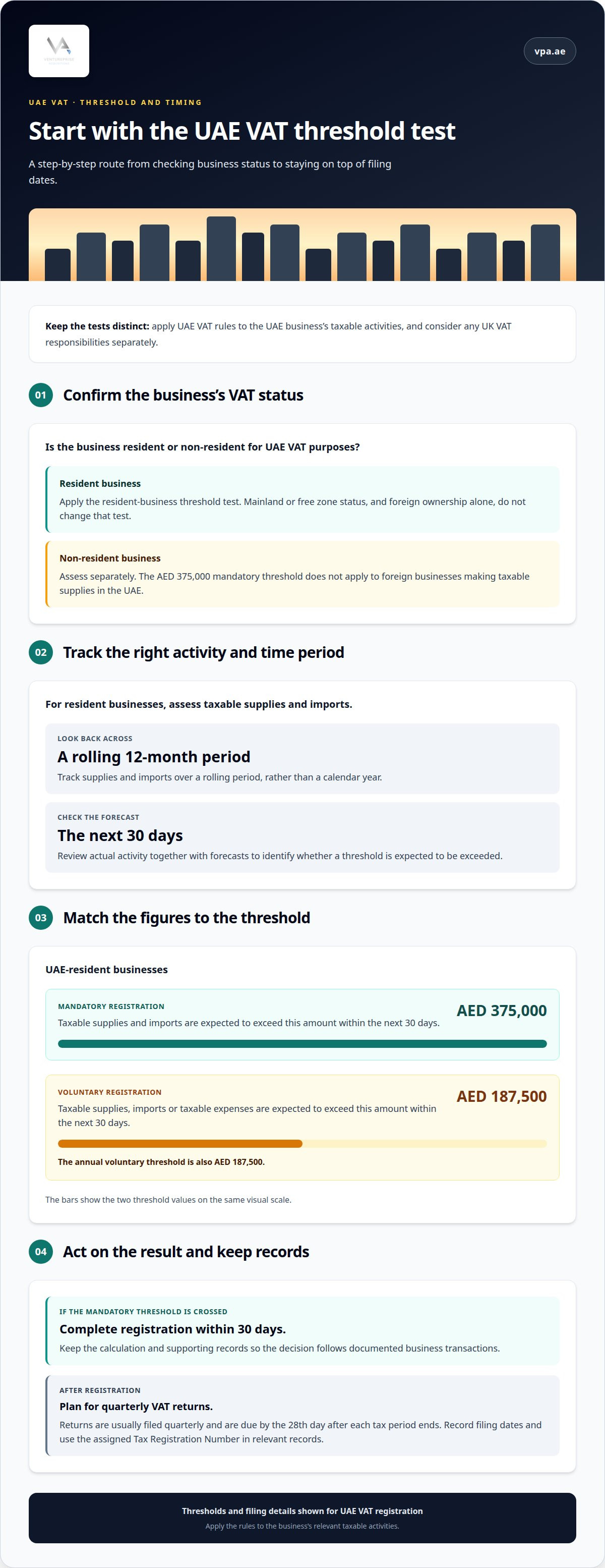
For UK-based founders establishing a UAE business, apply UAE VAT rules to that business’s taxable activities. The VAT registration process for new companies in UAE starts by identifying whether the business is resident or non-resident for VAT purposes.
Check the mandatory threshold for resident businesses
Track taxable supplies and imports over a rolling 12-month period, rather than a calendar year. According to the UAE Federal Tax Authority, UAE-resident businesses must register for VAT if their taxable supplies and imports are expected to exceed AED 375,000 within the next 30 days.
Review actual activity and forecasts together. If the mandatory threshold is crossed, complete registration within 30 days. Keep the calculation and supporting records so the registration decision follows the business’s documented transactions.
Compare mandatory and voluntary thresholds across UAE companies
Apply the resident-business test to mainland and free zone companies. Their location label or foreign ownership alone does not change the UAE-resident threshold test. UK founders should distinguish these UAE requirements from VAT obligations that may separately apply to their UK activities.
Consider voluntary registration when a UAE-resident business is below the mandatory threshold. It may register voluntarily if taxable supplies, imports or taxable expenses are expected to exceed AED 187,500 within the next 30 days. The annual voluntary threshold is AED 187,500.
Assess non-resident businesses separately. The AED 375,000 mandatory threshold does not apply to foreign businesses making taxable supplies in the UAE. Do not use that threshold to determine whether such a business must register.
Plan for continuing compliance after registration. UAE VAT returns are usually filed quarterly and due by the 28th day after each tax period ends. Record filing dates and use the assigned Tax Registration Number in relevant records. For UK founders, a clear VAT registration process for new companies in UAE means treating these UAE obligations separately from UK tax administration.
Application tracking and response to FTA queries
For a UK-based company seeking VAT registration across borders, prepare the application before submitting it through the relevant tax authority’s online service. Track its status afterwards and respond to requests using the authority’s specified process.
Prepare the account and supporting documents
Create the required online account and gather records explaining the company’s activities, taxable supplies, imports and expenses. Keep supporting documents consistent with the registration threshold calculation and the business details entered on the application. Check each file is legible and correctly labelled, so the reviewer can connect it to the relevant activity or figure.
Set aside enough time to complete each application field accurately. Review the details against company records before uploading documents. Where the application asks for evidence of business activity, provide material that shows what the company does and how its transactions support the information entered.
Check for common errors and penalties
Compare the application with its supporting records before submission. Mismatched business details, incomplete evidence or unclear descriptions of activities can prompt follow-up questions. Explain how the figures for supplies, imports and expenses support the expected registration position, and ensure the same definitions are used throughout the submission.
After submission, save the application reference and monitor the account for status updates or requests. Reply to each query with the specific explanation or document requested, using the authority’s stated channel. Keep copies of responses and uploaded evidence together, creating a clear record of what was submitted and when.
Continue tracking the application until the authority issues a decision. If it requests further information, respond promptly and address every point in the request. A complete, focused reply helps the reviewer assess the application without searching across unrelated records.
For help aligning a UK business launch with wider international plans, discuss your company formation plans.
EmaraTax account and taxable-person profile setup
Set up an EmaraTax account, then create the taxable-person profile before starting the VAT application. Accurate supply classifications and turnover figures give the Federal Tax Authority a clear basis for assessing your submission.
Create an account through the Federal Tax Authority’s eServices and use EmaraTax to begin VAT registration. Select the option for the correct taxable person, then enter the business details consistently across the profile and supporting records. A company is a separate legal person from its owners; a natural person conducts business in their own capacity.
Describe the business activities and the supplies they generate. Separate taxable, zero-rated and exempt supplies instead of combining them under one label. UAE zero-rated supplies are taxed at 0 per cent, whilst the standard VAT rate is 5 per cent. Apply the treatment that matches each supply when recording turnover.
Build the turnover calculation from the relevant transaction records. The earliest of invoicing, receiving payment, or delivering goods or services determines when UAE turnover is recognised for VAT purposes. Use this timing consistently, so transactions appear in the period that applies rather than being shifted to a convenient accounting date.
Include imports in the threshold assessment where relevant, and keep their records distinct from sales figures. The profile should make clear which amounts relate to supplies, imports and taxable expenses. This helps explain how the expected activity supports the registration position, especially where the business is approaching a threshold.
Review the taxable-person profile before submission. Check that the legal name, business activity, supply classifications and turnover calculation align with the records being uploaded. For a company with branches, present the business as one taxable person: all branches of a UAE company are registered under one Tax Registration Number, and one VAT return covers them.
Submit the application through EmaraTax and retain the completed profile information with the business’s VAT records. A clear distinction between taxable and exempt supplies helps prevent classification errors later, when the company prepares its VAT return and records the tax charged on sales.
What information is needed for UAE VAT registration?
Prepare consistent business and ownership details for the EmaraTax application. After approval, the Federal Tax Authority issues a VAT certificate containing the company’s Tax Registration Number.
Enter the taxable person’s legal name and business details as they appear in its company records. Describe the activities clearly, so the application explains what the business supplies and how its transactions relate to VAT registration.
Provide ownership information and record each owner’s shareholding percentage. The percentages must total 100%. For a company with several owners, check the figures together before submission; an incomplete ownership breakdown can make the application difficult to assess.
Organise supporting financial records that show the business’s transactions, supplies and imports. Include relevant sales tax invoices in the application documents. The VAT registration checklist includes at least three sales tax invoices, signed and stamped.
Review the application details against the documents before submitting them through EmaraTax. Keep the records used to support the expected registration position together. This creates a clear audit trail for the turnover figures and business activity represented in the submission.
Track the application in EmaraTax after submission. According to the UAE Federal Tax Authority, a completed VAT registration application is generally processed within 20 business days of receipt. The timing relates to a completed application, so respond to any request for supporting information through the platform.
After approval, open the taxpayer’s e-Services account dashboard to access the VAT registration certificate. It records a unique 15-digit Tax Registration Number, or TRN. Store the certificate with the company’s VAT records and use the TRN consistently in relevant tax documents and transactions.
Use the issued details to establish a consistent record-keeping process for future VAT returns. Keep the certificate accessible to the people responsible for preparing tax documents, and ensure the business’s records identify the same taxable person shown in EmaraTax.
For support coordinating registration details with a wider UAE business setup, discuss your company formation requirements.
Ventureprise Acquisitions
Ventureprise Acquisitions helps entrepreneurs plan their UAE market entry through Company Formation and Strategic Planning. If VAT registration questions arise alongside decisions about establishing or developing a UAE business, aligning the setup with your commercial plans can help clarify your next steps.
Turn to Ventureprise Acquisitions when you’re planning a new UAE presence and need to consider how company formation and strategic priorities fit together. Its guidance on Setting Up A Company In Dubai: 6 Myths That Will Hold You Back can also help challenge assumptions before you commit to a setup plan.
Contact Ventureprise Acquisitions to discuss your UAE business plans.
Make VAT planning part of your next move
A well-planned VAT registration process for new companies in the UAE should fit into a wider business strategy, rather than sit apart as an administrative task. As your company develops, decisions about its structure, commercial activities and financial processes can shape how confidently you manage growth.
Ventureprise Acquisitions supports entrepreneurs with Company Formation and Strategic Planning, helping connect business setup choices with wider objectives. Its guide, Setting Up A Company In Dubai: 6 Myths That Will Hold You Back, can also help you challenge assumptions as you plan your next step.
Use the approach that fits your company’s position, then bring your broader UAE plans into focus. Contact Ventureprise Acquisitions to discuss how your business setup and strategic priorities can work together. A clear plan gives you a stronger foundation for what comes next.
Frequently Asked Questions
How do you register for VAT?
Register online through EmaraTax by creating an account, opening the VAT registration service and completing the application for the taxable person. Prepare business and financial details in advance so the activities and figures you enter are consistent. Upload the supporting documents, submit the form, then monitor your account for status updates or requests from the Federal Tax Authority. Once approved, access the certificate through the taxpayer dashboard.
How do you calculate your annual turnover?
Assess taxable supplies across a rolling 12-month period, rather than relying on a calendar-year total. Record transactions consistently: for VAT timing, the earliest of invoicing, receiving payment or delivering goods or services determines when UAE turnover is recognised. For example, if payment arrives before an invoice is issued, use the payment date when assigning that transaction to the relevant period.
Which businesses does VAT apply to?
VAT applies to businesses making taxable supplies in the UAE, with registration obligations depending on residence and the applicable threshold. A free zone location does not by itself exempt a business from the VAT system, and foreign ownership does not change a UAE-resident company’s threshold test. Classify each supply correctly: zero-rated supplies remain taxable supplies, while exempt supplies are treated differently.
When can a new UAE company apply for voluntary VAT registration?
A UAE-resident company may apply voluntarily when taxable supplies, imports or taxable expenses are expected to exceed AED 187,500 within the next 30 days. Voluntary registration may also be available when supplies and imports exceed AED 187,500 per annum. A new company should base its assessment on its expected activity and supporting records, not just on the revenue already recorded since launch.
What documents are required for UAE VAT registration?
Prepare business records that explain the company’s activity, transactions, ownership and VAT position. The application checklist includes at least three sales tax invoices, signed and stamped. Ownership details should identify each shareholder’s percentage, with the percentages totalling 100%. Keep files legible and organised for upload; the FTA service accepts PDF documents up to 15 MB per document.
How do you register a company for VAT through the Federal Tax Authority EmaraTax portal?
Create an EmaraTax account through the Federal Tax Authority’s eServices, then select the VAT registration service and complete the company’s taxable-person profile. Enter its business and ownership details, provide the requested financial information, attach supporting documents and submit the application. Keep the submission reference and check the account for messages. If the FTA requests further evidence, respond through the platform with the relevant material.



Comments