

Mainland vs Free Zone Dubai: Choose for Your Market Goals
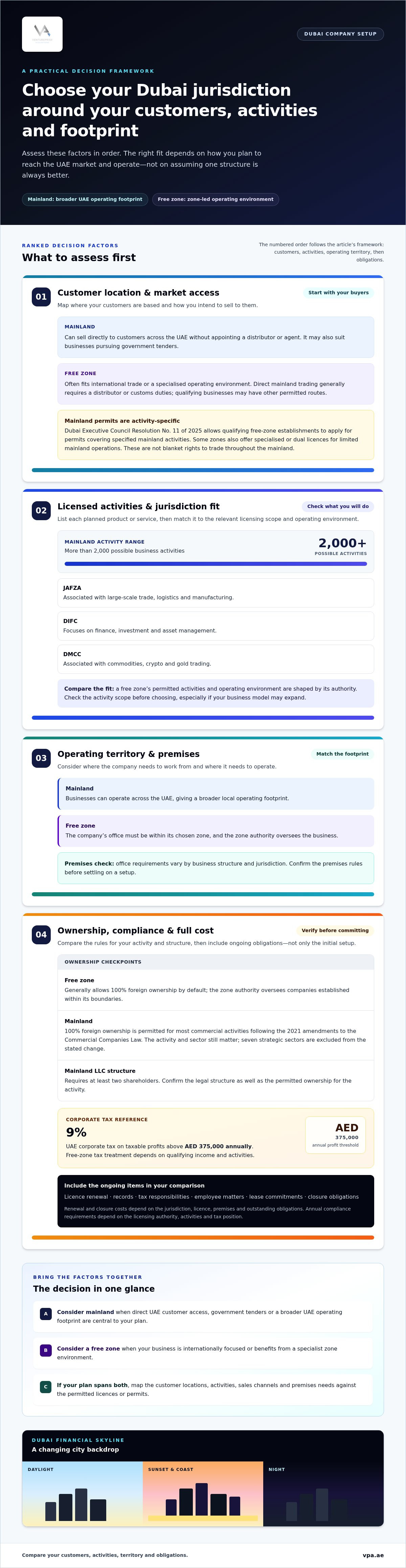
Mainland is often a better fit if you plan to sell directly to customers across the UAE. A free zone may suit a business focused on international trade or a specialised operating environment. The key to choosing between mainland and free zone in Dubai is to match market access and business activities to your growth plans, rather than assume one setup is always better.
It’s understandable to focus on ownership, tax and setup costs when comparing the options. But the practical difference is how each structure supports your customers, operations and access to the UAE market. This guide explains how mainland and free-zone setups differ, what each can offer, and which business goals may point towards one or the other. Use the framework to make a decision that supports your next stage of growth.
Table of Contents
Free Zone vs Mainland UAE 2026, Which Is Better for Your Company?
For foreign entrepreneurs, both Dubai free zones and mainland companies can allow 100% foreign ownership for many activities. The key distinction is how ownership rules apply to your chosen activity and company structure.
Free-zone company ownership
Free-zone companies generally allow 100% foreign ownership by default, without requiring a local partner or sponsor. Each free zone has its own authority, which oversees companies established within its boundaries. That means your chosen zone shapes the rules and setup framework for your company. For example, an entrepreneur can own the whole company, while employees and shareholders operate within the zone’s regulatory structure.
Mainland company ownership and licensing
Mainland ownership has changed: since the 2021 amendments to the Commercial Companies Law, 100% foreign ownership is permitted for most commercial activities. The permitted shareholding still depends on the business activity and sector, with seven strategic sectors excluded from the stated change. A mainland company is licensed through the relevant mainland licensing framework. A mainland LLC requires at least two shareholders, so consider the legal structure as well as the ownership percentage.
The current rules differ sharply from the historic mainland model. Foreign ownership was historically limited to 49%, with UAE nationals holding the remaining 51%. That former arrangement should not be treated as the default for every mainland company today. Instead, identify the exact activity first, then establish whether its sector allows full foreign ownership. This sequence helps entrepreneurs assess ownership before committing to company formation.
First, confirm the ownership rules for your business activity, then compare the relevant company structures and regulatory requirements.
Access to UAE domestic and international markets
Market access should guide your choice of Dubai jurisdiction. A mainland company can sell directly to customers across the UAE without appointing a distributor or agent. It may also be suitable if you plan to pursue government tenders. Map your intended customers first: UAE-based buyers, government entities and overseas clients may call for different operating models.
A free-zone company’s route into the UAE mainland market works differently. Direct mainland trading generally requires a distributor or customs duties, but Dubai’s rules provide additional routes for qualifying businesses. Dubai Executive Council Resolution No. 11 of 2025 allows qualifying free-zone establishments to apply for permits covering specified mainland activities. Some free zones also offer specialised or dual licences for limited mainland operations. The permitted scope matters: a licence for specified activities isn’t a blanket right to trade throughout the mainland.
Both structures can support international business, but their operating footprints differ. A free-zone company’s office must be within its chosen zone, whose authority oversees the business. This may suit an entrepreneur whose customers and operations are built around that zone. A mainland company offers a broader UAE operating footprint. If you plan to sell directly to UAE customers and export overseas, assess both routes against your sales channels, activities and premises needs before forming the company.
Your business activities are central to the decision. List what you plan to do, identify where each customer is based, then map the licences or permits needed. For example, a company focused on overseas clients may favour a free-zone structure, while one pursuing UAE government contracts may need mainland access. If local sales are occasional, available free-zone permits may affect the comparison. Rules and flexibility depend on the activity and licence, not simply the company’s address.
If your plan spans UAE and international customers, a company formation discussion can help translate those market requirements into a clear setup decision.
Choosing a jurisdiction based on business goals
Start with your customers, licensed activities and planned operating footprint across the UAE. Then compare each jurisdiction’s practical requirements with your growth plans.
JAFZA is associated with large-scale trade, logistics and manufacturing, while DIFC focuses on finance, investment and asset management. DMCC is associated with commodities, crypto and gold trading. Compare each zone’s activity fit and package structure with your budget.
Business activities and operating territory
Dubai mainland offers more than 2,000 possible business activities, making it relevant when your plans span sectors or locations. Mainland businesses can operate across the UAE. By contrast, a free zone’s permitted activities and operating environment are shaped by its authority. Match each planned service or product to its licensing scope before selecting a jurisdiction, especially if your business model may expand.
Business substance and compliance obligations
Substance means aligning your premises and operations with the selected structure. Office requirements can vary by business structure and jurisdiction, so confirm the premises rules before choosing a setup. Annual compliance and renewal requirements depend on the licensing authority, activities and tax position. UAE corporate tax is 9% on taxable profits above AED 375,000 annually; free-zone tax treatment depends on qualifying income and activities.
Renewal and closure costs depend on the jurisdiction, licence, premises and outstanding obligations. Make a checklist covering licence renewal, records, tax responsibilities, employee matters and lease commitments, and include each item when comparing structures. This keeps closure planning in view alongside initial formation.
Visa quotas and office space requirements
Free-zone visa quotas are tied to office size or the selected flexi-desk package, so planned headcount should inform your premises choice. Mainland visa allocation is flexible based on office size. Estimate the space your operations and employees need, then compare it with the visa capacity attached to each setup. A compact workspace may limit free-zone hiring plans.
Choose the jurisdiction whose activity permissions, office model and compliance requirements support your intended scale.
Mainland company benefits and costs
A mainland company can operate across the UAE. This may justify higher setup costs when local reach is central to revenue. Dubai mainland licensing is handled by the Department of Economic Development (DED). Budget for the licence and a physical office, then assess ongoing premises and operating costs. This structure may suit logistics businesses needing a local footprint or companies pursuing international trade alongside UAE sales.
Free-zone setup costs vary by authority, activity and package. Compare the licence with the selected workspace, visa allocation and renewal requirements, rather than judging the decision by the initial licence alone. A compact package may limit premises and visa capacity, while a larger office increases the overall commitment. For a company centred on overseas clients, those trade-offs may still make a free zone the more practical fit.
Office costs are a major difference. Mainland companies must lease physical office space; flexi-desks and virtual offices are not accepted under the stated mainland requirements. Some Dubai free zones offer virtual-office options, but the company’s office must remain within its chosen zone. Compare the premises needed for actual operations, not just the licence fee. A logistics operator, for example, may need different workspace from a consultancy.
Compare first-year and renewal costs in separate lines for licensing, premises, visas and recurring operating needs. Include the relevant authority’s renewal terms and any costs associated with changing or closing the business. Costs depend on the selected activity, location and facilities, so compare like-for-like packages. A mainland licence may cost more initially, but access to customers across the UAE can affect the commercial return.
Make the decision with a full cost model: list required operations, office needs and target markets, then weigh them against each setup’s benefits. Explore Dubai company formation options as you shape the structure around your commercial priorities.
Ventureprise Acquisitions: Setting Up A Company In Dubai: 6 Myths That Will Hold You Back
Ventureprise Acquisitions helps UK-based entrepreneurs and international founders plan company formation for entering the Dubai market. If you’ve weighed mainland access against a free-zone structure but still need to align your activities, operating footprint and growth priorities, the firm’s Company Formation and Strategic Planning services can help you shape the next steps.
The guide Setting Up A Company In Dubai: 6 Myths That Will Hold You Back can help challenge assumptions before you commit to a setup. For business owners also considering longer-term wealth arrangements, Ventureprise Acquisitions offers specialist private client wealth structuring, foundations and trusts.
Contact Ventureprise Acquisitions today to discuss your Dubai business plans and the structure that best fits your goals.
Turn your Dubai market plan into action
A sound approach to choosing between mainland and free zone in Dubai starts by turning market priorities into practical decisions. Treat the jurisdiction as part of a wider operating strategy, not an isolated registration choice. Define your activities, customer reach and capacity needs, then align the setup with a realistic growth path.
Ventureprise Acquisitions can support that next step through company formation and strategic planning, helping shape the setup around your commercial direction. Its guide, Setting Up A Company In Dubai: 6 Myths That Will Hold You Back, offers another way to challenge assumptions before moving ahead. Use this stage to turn analysis into a clear action plan, with priorities and responsibilities set out from the start.
When you’re ready to progress, contact Ventureprise Acquisitions to discuss your Dubai business plans. A deliberate decision now gives you a focused platform for future growth.
Frequently Asked Questions
Why set up a business in a Dubai Free Zone?
A Dubai free zone may suit a business seeking a specialised commercial environment and an international focus. Choose a zone whose activities align with your venture: JAFZA is associated with logistics, manufacturing and large-scale trade, while DIFC focuses on finance and investment. DMCC is linked with commodities, crypto and gold trading. A zone’s industry focus can help shape a setup around your operating model.
Is it Easy to Start a Business in Dubai?
Starting a business can be straightforward when you settle the activity, legal structure and licensing route before applying. Standard UAE free-zone incorporation typically takes from a few days to two weeks; mainland incorporation typically takes two to six weeks. Begin by defining what the company will do, then select a suitable jurisdiction and prepare the application around its activity requirements.
What are the Disadvantages of Free Zones in UAE?
The main trade-off is that a free-zone licence doesn’t automatically provide unrestricted access to UAE mainland customers. Office location and visa capacity can also affect expansion: premises must be within the selected zone, and free-zone visa quotas relate to office size or flexi-desk packages. Tax advantages depend on qualifying income and activities, so a zone’s headline benefits may not fit every business model.
What is the Mainland in Dubai?
Dubai mainland means establishing a company under the emirate’s mainland licensing framework rather than within a designated free zone. The Department of Economic Development licenses mainland companies, which can operate across the UAE. For example, a business planning to serve customers in different emirates or pursue government tenders may value this broader operating reach. Approved activities and premises remain central to the setup.
What are the key differences between Dubai mainland and free zone company setups?
The core differences are licensing authority, operating territory, premises and routes to customers. A mainland company is licensed through Dubai’s Department of Economic Development and can operate across the UAE. A free-zone company is overseen by its zone authority and operates within that framework. When choosing between mainland and free zone in Dubai, map the company’s activities and customer locations against these conditions.
Can a Dubai free zone company trade directly with mainland customers?
Not as a general, unrestricted right. A free-zone company typically reaches mainland customers through a distributor or by paying customs duties, while qualifying businesses can apply for permits covering specified mainland activities under Dubai Executive Council Resolution No. 11 of 2025. Some zones also offer specialised or dual licences for limited mainland operations. The permitted activities define the scope, rather than the licence alone guaranteeing broad access.



Comments