
_svg.png)
The Definitive Dubai HR Strategy for Startups: A 2026 Strategic Template for Growth
Updated: Jul 17
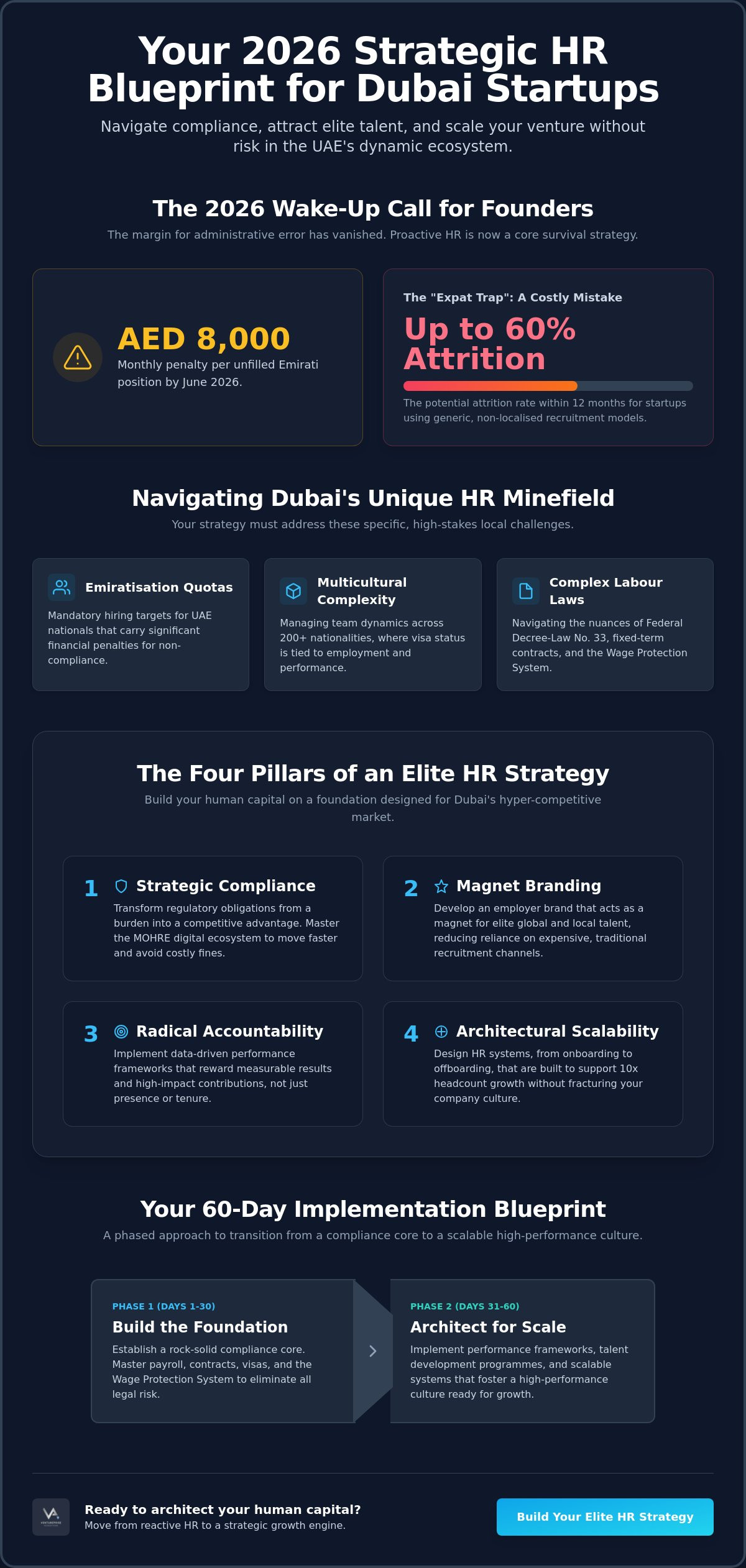
By June 2026, a single unfilled Emirati position on your payroll will trigger a monthly penalty of AED 8,000. In a market where Dubai is projected to host over 3,500 active startups by year-end, the margin for administrative error has vanished. You likely recognise that your people are your greatest asset, yet the sheer complexity of UAE labour laws and evolving Emiratisation quotas can make talent management feel like a legal minefield. A robust Dubai HR strategy for startups is no longer a luxury for the back office; it's the strategic engine that powers your ability to scale without being derailed by recruitment mistakes or regulatory fines.
You want to focus on innovation and market capture, not on the minutiae of fixed-term contracts or the Wage Protection System. We understand that managing a multicultural team whilst navigating a 9% federal corporate tax landscape requires more than just intuition. This article provides a definitive 2026 strategic template to master the Dubai talent market. We'll show you how to build a high-performance culture that survives the startup phase, mitigates every legal risk, and ensures your organisation remains an elite destination for global talent.
Table of Contents
Why Generic HR Strategies Fail in Dubai’s 2026 Startup Ecosystem
Founders often make the fatal mistake of importing carbon-copy recruitment models from London or New York, assuming talent dynamics are universal. They aren't. In the high-velocity 2026 market, where Dubai is projected to host over 3,500 active startups, this "Expat Trap" leads to catastrophic results. Industry professionals report that misaligned hiring frameworks can result in attrition rates as high as 60% within the first twelve months. A generic Dubai HR strategy for startups fails because it ignores the unique interplay between residency status, tax-free incentives, and the rapid diversification of Dubai's economic landscape. You cannot scale a visionary venture on a foundation of borrowed, outdated templates.
The 2026 ecosystem moves at a speed that demands your HR strategy be as agile as your product roadmap. With the UAE government committing over $100 billion to AI investments, the competition for specialised technical talent has reached an all-time high. Many entrepreneurs still believe HR is a "Series B" concern, reserved for large corporations. This is a myth that costs money. Poor job design in a high-inflation environment, coupled with the new AED 6,000 minimum wage for Emirati nationals, creates a burn rate that can swallow your seed funding before you reach your first milestone. Precision in human capital is your only defence against rising operational overheads.
The Multicultural Complexity of a Dubai Workforce
Managing a team that spans 200+ nationalities requires more than just a "cultural awareness" workshop. It demands sophisticated operational integration. In Dubai, an employee's visa status is inextricably linked to their professional performance and loyalty; it's a unique psychological contract that doesn't exist in western markets. High-performance teams here rely on rigid communication protocols that bypass linguistic nuances. If your internal behaviour standards don't account for these multicultural friction points, your culture will fracture as soon as you scale beyond the founding team.
Operational Excellence as the Foundation
Building a resilient organisation starts with treating people operations as a core engineering task. HR is the critical first step in achieving Dubai business operational excellence. It isn't merely about payroll; it's about linking every hire to your broader strategic management consulting goals. To survive the 2026 market, your HR function must be supported by a robust IT infrastructure that automates compliance whilst providing real-time data on talent ROI. This level of sophistication ensures that your Dubai HR strategy for startups remains a catalyst for growth rather than a bureaucratic bottleneck.
The Four Pillars of an Elite HR Strategy for Dubai Startups
Stop viewing HR as a defensive administrative shield. In the UAE's hyper-competitive ecosystem, an elite Dubai HR strategy for startups functions as a high-performance engine designed to outpace the market. You aren't just hiring employees; you are acquiring human capital in one of the world's most dynamic jurisdictions. Success requires a framework built on four non-negotiable pillars: strategic compliance, magnet branding, radical accountability, and architectural scalability. If your current setup feels like a bottleneck, it's likely because one of these foundations is fractured.
The transition from a "founder-led" team to a scalable organisation is where most startups fail. By 2026, the complexity of local regulations means that "winging it" is no longer an option. You must build systems today that support a 10x headcount tomorrow. This involves moving beyond basic payroll to implementing performance frameworks that reward results over mere presence. High-growth environments demand radical accountability; your HR strategy must be the mechanism that enforces it whilst providing the psychological safety your team needs to innovate.
Pillar 1: Strategic Regulatory Compliance
Compliance is your competitive edge, not a chore. Mastering the MOHRE digital ecosystem allows you to move faster than competitors bogged down by red tape. In 2026, sophisticated founders are moving beyond basic gratuity calculations to integrated end-of-service benefit funds that offer better returns for staff whilst protecting company liquidity. Drafting contracts that act as both a legal shield and a talent magnet is essential. This isn't just about following rules; it's about building institutional trust that allows you to attract the top 1% of global talent without friction.
Pillar 2: Talent Acquisition and Employer Branding
To win the talent war, you must architect a "Magnet Brand". Your Dubai startup cannot simply be a satellite of your international entity; it needs a distinct Value Proposition. Elite executives aren't just looking for a tax-free salary; they want the long-term security of a Golden Visa and superior residency perks. By leveraging specific Dubai business setup requirements, you can offer bespoke residency benefits that traditional corporations struggle to match. Understanding the nuances of startup regulations in Dubai's free zones is essential for crafting these high-value employment packages. If you want to ensure your framework is optimised for this level of growth, you should speak with a strategic advisor to audit your current setup.
Navigating the 2026 Regulatory Landscape: Compliance as a Competitive Tool
In the UAE, regulatory compliance is the filter that separates visionary enterprises from temporary experiments. A high-performance Dubai HR strategy for startups doesn't just "follow the law"; it leverages these frameworks to build institutional resilience. As of 2026, the enforcement of Federal Decree-Law No. 33 of 2021 has reached a point of absolute transparency, where digital systems like the Wage Protection System (WPS) leave no room for administrative oversight. If your payroll isn't automated and your insurance systems aren't integrated, you aren't just risking a fine; you're signalling to elite talent that your infrastructure is amateur. Implementing HR best practices for startups in Dubai means moving toward 100% digital compliance to ensure your scaling remains frictionless.
The 2026 fiscal year has introduced stricter financial implications for non-compliance. Whilst many founders focus on the 9% corporate tax, the hidden costs of HR errors are often higher. Managing "Unregulated Market" risks is paramount; you must ensure your HR and visa providers are legitimate entities. Cutting corners with unlicensed facilitators can lead to visa freezes or the total suspension of your commercial operations, an outcome that no amount of Series A funding can fix. Authenticity in your partnerships is the only way to safeguard your human capital.
Emiratisation: From Quotas to Strategic Integration
For startups with 20 to 49 employees in 14 specific sectors, the 2026 landscape is critical. You were required to have a second Emirati national on your payroll by the end of 2025; failing to maintain this in 2026 leads to fines of up to AED 108,000. However, savvy founders view this as an opportunity rather than a burden. The Nafis programme provides significant salary subsidies and pension support, effectively reducing your startup budget whilst you secure high-tech local talent. Integrating Emirati professionals into your core team isn't just a quota exercise; it's a strategic move to localise your brand's DNA in a market that rewards long-term commitment.
Labour Law Nuances for Remote Founders
Managing a Dubai-based team whilst you remain in the UK or elsewhere is a logistical reality for many modern founders. Whilst Federal Decree-Law No. 33 of 2021 mandates fixed-term contracts and specific working hour limits, practical oversight requires more than just a legal document. Utilising Dubai corporate governance services allows you to maintain rigorous HR oversight from a distance. You don't need to be on the ground daily to build a high-performance culture, but you do need an authoritative partner to ensure your operational behaviour aligns with local interpretations of the law. This framework removes the friction of international expansion, allowing you to focus on growth whilst we handle the regulatory heavy lifting.
Your 2026 Startup HR Strategy Template: From Foundation to Scale
Execution is the only differentiator that matters. Implementing a Dubai HR strategy for startups isn't a one-off event; it's a 90-day sprint toward operational maturity. Founders often lose momentum by getting bogged down in administrative minutiae, failing to see that HR is a series of interconnected systems. To scale effectively in the 2026 market, you must move through four distinct phases that transition your organisation from basic legal compliance to a high-performance culture. This phased approach ensures your foundation is ironclad before you attempt to accelerate growth.
For remote founders based in the UK or Europe, this template is your primary management tool, and you can also learn more about Pioneer HR for specialised consultancy from a UK perspective. You cannot rely on "office vibes" to maintain standards from a distance. You need a framework that provides absolute visibility into your team's output and regulatory status. By following this 90-day blueprint, you remove the guesswork and build a business that is resilient, compliant, and ready for 10x headcount expansion.
Phase 1: Architecting the Compliance Core
The first 30 days are dedicated to securing your legal right to operate. Securing your MOHRE establishment card and e-signature card is the non-negotiable first step. Without these, your recruitment remains an informal arrangement with zero legal standing. You must standardise your offer letters and employment contracts to align with the 2026 interpretations of Federal Decree-Law No. 33 of 2021. This includes ensuring all staff are on fixed-term contracts and that your payroll is fully integrated with the Wage Protection System (WPS). If your payroll doesn't flow through a central bank-approved system, you face immediate visa freezes and financial penalties.
Phase 2 & 3: Culture and Performance
Days 31 to 90 shift the focus from administrative survival to cultural dominance. Defining "The Dubai Way" is essential in a transient city where talent often moves for a 10% salary increase. You must build a culture that anchors elite talent through career velocity and radical accountability. This involves setting performance KPIs that align directly with your broader strategic planning for Dubai startups. The Ventureprise Acquisitions approach focuses on removing professional barriers by creating a meritocratic environment where results are the only currency. This ensures that whilst you are managing from afar, your team remains obsessed with delivery.
Once you reach Day 90, you enter the Scaling Framework. This is where your systems must be robust enough to handle rapid hiring without breaking your culture or your bank balance. If you want to ensure your organisation is built for this level of advancement, you can book a strategic consultation with our experts to audit your 90-day roadmap.
Executing Operational Excellence: How Ventureprise Acquisitions Architects Your Human Capital
Obtaining your trade licence is a significant milestone, but it isn't the finish line. Many founders celebrate prematurely, failing to realise that company formation accounts for only 10% of your operational success. The remaining 90% is won or lost in the execution of your Dubai HR strategy for startups. At Ventureprise Acquisitions, we don't just facilitate your market entry; we architect the human capital systems that ensure you stay. We transform HR from a back-office burden into a strategic asset that drives your valuation and protects your burn rate.
Our management consulting framework is designed to remove every point of friction from your international expansion. We understand the unique pressures faced by ambitious founders moving into the UAE. There is a critical synergy between your corporate performance and your personal wealth structuring for UK entrepreneurs in Dubai. A failure to align your HR compliance with your broader wealth goals can lead to unnecessary tax exposures or legal liabilities that threaten your long-term security. Ventureprise Acquisitions ensures your professional and personal structures work in total harmony.
Beyond the Setup: Long-Term Strategic Partnership
We take a position of active partnership rather than passive service provision. This begins by helping you debunk the pervasive business setup myths in Dubai that often encourage founders to ignore talent retention until it's too late. As your elite guide in the Middle East, Ventureprise Acquisitions provides the specific keys to unlocking professional potential. For high-net-worth founders, we build customised HR infrastructure that mirrors the sophistication of your global operations. This ensures your local presence is as prestigious as your international reputation whilst remaining fully compliant with 2026 regulations.
Your Direct Path to Dubai Success
Efficiency in 2026 requires more than just knowing the rules; it requires direct authority relationships. We eliminate the middlemen who slow down your hiring processes and complicate your visa applications. This direct approach allows for a faster, more reliable execution of your Dubai HR strategy for startups. Our strategic planning isn't theoretical; it's a catalyst for tangible growth that dismantles professional barriers and builds a case for immediate action. You have the vision; Ventureprise Acquisitions provides the operational excellence to make it a reality. Enquire about our Strategic Management Consulting today to begin your transformation.
Mastering the 2026 Talent Frontier
In the high-velocity 2026 market, your ability to scale depends entirely on the sophistication of your operational infrastructure. You've seen that a generic approach leads to attrition and legal exposure; success requires a Dubai HR strategy for startups that treats compliance as a competitive advantage. By following the 90-day blueprint from foundation to scale, you ensure that your organisation is built for 10x growth rather than administrative stagnation. Execution is everything.
Ventureprise Acquisitions provides the elite guidance necessary to navigate this transition. Operated by angel investors and business strategists, we bring a results-driven energy to your international expansion. We leverage our direct authority relationships with UAE government bodies to remove professional barriers and accelerate your hiring timeline. Our deep expertise in UK-to-Dubai expansion ensures that your transition is seamless and strategically optimised.
Don't let administrative friction hold back your vision. It's time to move from market entry to market dominance with a partner invested in your long-term success. Your expansion starts here.
Frequently Asked Questions
Does a startup in Dubai really need a formal HR strategy from Day 1?
Waiting to implement a formal strategy is a high-risk gamble that most founders lose. A robust Dubai HR strategy for startups is essential from the first hire to ensure immediate compliance with the Wage Protection System and to avoid the 60% attrition rates common in the "Expat Trap". It establishes the high-performance culture required to scale whilst protecting your intellectual property and seed capital through ironclad, localised contracts.
What are the mandatory Emiratisation requirements for startups in 2026?
By the end of 2026, companies with 50 or more employees must reach a 10% Emirati headcount in skilled roles, with a critical mid-year milestone of 8% by June 30th. For smaller startups with 20 to 49 employees in specific sectors, you must have maintained at least two Emirati nationals on your payroll since the start of the year. Non-compliance triggers monthly penalties of AED 8,000 per unfilled position for larger firms.
How much does it cost to set up an HR function for a Dubai startup?
Operational costs are driven primarily by visa processing and mandatory insurance. In 2026, the average cost for an employee visa ranges between AED 5,500 and AED 6,500, which includes medical tests, Emirates ID, and insurance. Whilst licensing fees in zones like IFZA or Meydan start around AED 12,500, your HR budget must also account for the AED 6,000 minimum monthly wage now mandatory for Emirati nationals in the private sector.
Can I manage my Dubai team’s HR requirements whilst living in the UK?
You can effectively manage your team from a distance by leveraging the UAE’s advanced digital MOHRE ecosystem. Success for remote founders depends on implementing rigorous corporate governance and automated payroll systems that provide total visibility into employee output and legal status. This remote-first approach allows you to maintain strategic control whilst your local infrastructure handles the day to day regulatory heavy lifting.
What is the Wage Protection System (WPS) and is it mandatory for startups?
The Wage Protection System is a mandatory electronic salary transfer mechanism that monitors every private sector payroll to ensure employees are paid correctly and on time. All mainland companies and the majority of free zone entities must use it. Failure to pay through an approved WPS provider leads to immediate visa blocks and significant fines, making it the most critical technical component of your Dubai HR strategy for startups.
How do Dubai labour laws differ between Free Zones and the Mainland for HR?
Most free zones now align directly with Federal Decree-Law No. 33 of 2021, meaning the core rules regarding fixed-term contracts and working hours are consistent across Dubai. However, financial free zones like DIFC and ADGM operate under their own independent employment laws with different rules regarding gratuity and dispute resolution. You must ensure your HR framework is tailored to the specific jurisdiction of your trade licence to avoid legal misalignment.
What are the "end-of-service" gratuity requirements for employees in the UAE?
Employees who complete at least one year of service are entitled to a gratuity payment based on their final basic salary. Under current laws, this is calculated as 21 days of basic pay for each of the first five years and 30 days for every year thereafter. Many startups are now opting into the new voluntary savings scheme, which allows you to pay monthly contributions into an investment fund rather than carrying a large liability on your balance sheet.
How can a startup use the Golden Visa as part of its HR recruitment strategy?
The Golden Visa is your most powerful tool for attracting elite global executives who value long-term residency and independence from a single employer. By sponsoring high-calibre talent for 10-year visas based on specialised skills or high salaries, you offer a level of security that traditional startups cannot match. This strategy transforms your organisation into a "Magnet Brand", securing the loyalty of top-tier professionals in a transient market.



Comments