

UAE Labour Law for Employers: Contracts, Hours and Overtime
A UK employment contract does not shield an employer from mandatory UAE rules when staff work in Dubai. A practical understanding of UAE labour law for employers starts with the local framework: private-sector contracts are fixed-term and can last up to three years. Probation is capped at six months, while standard working hours are limited to eight hours a day or 48 hours a week.
Keeping a UK contract in place may seem like the simplest way to manage a relocation, but it does not remove the need to meet UAE employment requirements. This guide explains how the rules affect relocated staff, what probation means for employers and employees, and how working hours and overtime are treated. It also explains why the distinction between the UAE’s federal private-sector framework and other employment systems matters when planning a move. Understanding the core rules helps you manage the transition and avoid preventable surprises.
Table of Contents
Do UK employment contracts apply to staff relocated to Dubai?
No. A UK contract does not protect an employer from mandatory UAE rules when staff work in Dubai. Federal Decree-Law No. 33 of 2021 governs private-sector employment and came into force on 2 February 2022. Employers must therefore account for local legislation, even when a UK agreement remains part of the arrangement.
UAE private-sector employment contracts are written and fixed-term, and can last up to three years. They should state the job title and description, salary, and contract duration. Contracts for staff in Dubai must be registered with MOHRE or the relevant free zone authority. A UK contract alone does not replace these local requirements.
For example, a UK employer relocating a worker should align the Dubai employment contract with the role and pay arrangements in practice. Notice terms also need attention: UAE employment contracts generally provide for 30 to 90 days’ notice, unless otherwise agreed. Employers should consider statutory benefits, including gratuity, alongside salary and contract terms.
Mainland employers generally follow the federal private-sector framework. DIFC and ADGM have distinct common-law employment systems, so the applicable rules depend on where the worker is employed.
For foreign employees, the employer arranges work authorisation and the visa process through the relevant mainland or free zone authority. Registering the contract with MOHRE or the applicable free zone authority is part of setting up the employment.
Breaches can expose employers to disputes and financial penalties. For example, UAE private-sector employers can be fined AED 20,000-100,000 for providing false information to recruit an expatriate worker. The Ministry of Human Resources and Emiratisation can assist with employment disputes through mediation or adjudication.
Understanding the contract framework means distinguishing UK paperwork from the obligations that apply to work in Dubai. Before relocation, align the employment contract, registration route, salary terms, notice arrangements and statutory benefits with the UAE rules that apply to the employing establishment.
What is the maximum probationary period under UAE Labour Law?
Under Federal Decree-Law No. 33 of 2021, probation for UAE private-sector employees cannot exceed six months. The employer must give 14 days’ written notice to end employment during probation. A clear written record of the start date helps both parties understand when this period ends.
Notice rules change if an employee resigns during probation. Someone leaving the UAE must give 14 days’ notice, whilst an employee moving to another UAE employer must give one month’s notice. These separate requirements matter during recruitment planning: a start date with a new employer may depend on the outgoing employee’s notice.
After probation, the employment contract sets the notice period, generally from 30 to 90 days. Employers should align termination decisions, written notice and final payments with the contract and UAE requirements. Avoid treating probation notice as the default once an employee has completed probation.
End-of-service gratuity is a separate entitlement from notice pay. Expatriate employees who complete over one year of service accrue gratuity. The calculation is based on 21 days of basic wage per year for the first five years, then 30 days per year after the first five years. Employers should include this liability in workforce planning.
Termination calculations should also account for outstanding salary, unused annual leave and other contractual entitlements. Employers must pay end-of-service gratuity and other termination payments within 14 days of the termination date. Keep the calculation and payment records together with the written notice, so the final settlement is transparent.
Salary rules focus on paying the agreed wage. Mainland employers must pay salaries through the electronic Wage Protection System (WPS), and wages are due no later than the 14th day of the month following the wage period. Include salary and payment terms clearly in employment records.
For employers, distinguish between termination during probation, resignation during probation and termination after probation. Each has its own notice requirements, while service length affects gratuity and other final entitlements. Applying the correct rule at each stage helps manage recruitment transitions and avoid miscalculations.
Working hours and overtime
Federal private-sector rules limit ordinary working hours and additional work. Build schedules and payroll procedures around those limits and the applicable overtime obligations.
Working Hours
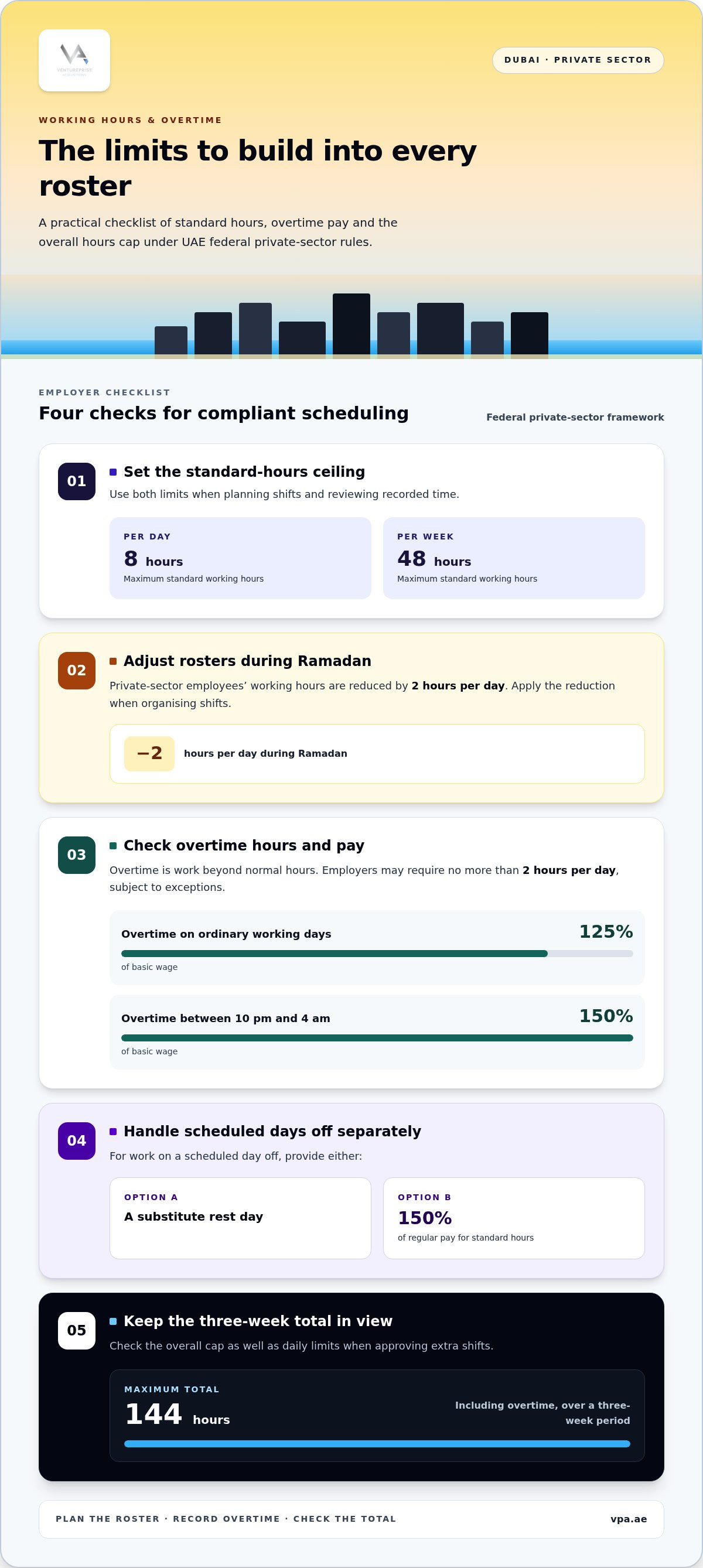
Standard working hours are capped at eight hours per day or 48 hours per week. These limits give employers a clear basis for scheduling shifts and reviewing recorded time. During Ramadan, private-sector employees’ working hours are reduced by two hours per day. Apply that reduction when organising rosters, rather than treating the usual schedule as unchanged throughout the month.
Overtime Limits and Pay
Overtime is work beyond normal hours, subject to daily limits and additional pay. Employers may require no more than two hours of overtime per day, subject to exceptions. For overtime on ordinary working days, employees receive 125% of basic wage. Work between 10 pm and 4 am attracts 150% of basic wage. Keep overtime hours and the applicable pay calculation distinct in payroll records.
Work on a scheduled day off has a separate treatment: provide a substitute rest day or compensation at 150% of regular pay for standard hours. The overall limit is also relevant: private-sector employees may work a maximum of 144 total hours, including overtime, over a three-week period. Check both the daily and three-week limits when approving extra shifts.
Rest and leave entitlements affect how schedules operate. UAE private-sector employees are generally entitled to at least one paid rest day each week. Employees who complete one year of service are entitled to 30 calendar days of paid annual leave per year. Plan cover around those absences; don’t treat annual leave as overtime or a substitute rest day.
For practical compliance, record scheduled and actual hours, overtime approval, and the basis used to calculate pay. Compare timesheets with payroll, then review Ramadan rosters and scheduled rest days separately. Probation does not remove working-hours obligations, and service gratuity is a separate end-of-service entitlement, not overtime pay.
UAE private-sector employment law
Federal Decree-Law No. 33 of 2021 governs most UAE private-sector employment relationships across the seven emirates. Identifying the right framework first helps employers set contracts and workplace procedures correctly.
Scope of Private-Sector Employment Law
The federal framework sets employment rules for private-sector employers and workers, including UAE nationals and expatriates. It recognises full-time, part-time, temporary and flexible work models. The chosen model should match the working arrangement and be stated in the employment contract. DIFC and ADGM have distinct common-law employment systems, so their employees fall outside the general federal framework.
Exempt Employees and Sectors
UAE Labour Law does not cover federal and local government employees, armed forces, police and security employees, or domestic workers. Domestic workers are governed separately by Federal Decree-Law No. 9 of 2022. Employers should identify the worker’s sector and employing entity before applying federal private-sector provisions; the label “free zone” alone does not mean the same employment rules apply everywhere.
Employer Steps for Labour Law Compliance
Start with a written contract that records the agreed job title, job description, salary and duration. Private-sector contracts are fixed-term; register employment contracts with MOHRE or the relevant free zone authority. These steps establish the correct terms and official employment record. Mainland employers must pay salaries through the electronic Wage Protection System, with wages due no later than the 14th day of the month following the wage period.
Then align workplace procedures with statutory entitlements. Provide at least one rest day each week, and account for 30 calendar days of paid annual leave after one year of service. Keep records that connect the contract, salary payment, hours and leave. Review the rules when a worker’s role or work model changes, rather than relying on an outdated agreement.
Planning a Dubai business presence? Discuss company formation and market-entry planning as part of your setup strategy.
Ventureprise Acquisitions: Setting Up A Company In Dubai: 6 Myths That Will Hold You Back
Ventureprise Acquisitions helps UK entrepreneurs connect Dubai company formation with strategic planning. Once you understand the employment framework, the next challenge is building a business structure that can support your intended operations and workforce. Its company formation and strategic planning offerings can help you shape that market-entry plan, while Setting Up A Company In Dubai: 6 Myths That Will Hold You Back addresses common assumptions about establishing a business in Dubai.
Use this guidance when assessing a Dubai presence, preparing to relocate staff or aligning business setup decisions with operational priorities. A clear view of your proposed structure and workforce needs provides a stronger basis for those decisions.
Visit Ventureprise Acquisitions to discuss Company Formation and Strategic Planning for your Dubai ambitions.
Turn your Dubai plans into a clear operating strategy
Understanding UAE labour law for employers is one part of a successful move into Dubai. The next step is to connect workforce decisions with your wider business structure, commercial priorities and growth plans. Treat relocation as an operational decision, not simply a change of address.
Ventureprise Acquisitions supports that planning through Company Formation and Strategic Planning. Its guide, Setting Up A Company In Dubai: 6 Myths That Will Hold You Back, can also help you challenge assumptions before committing to a market-entry approach. Bringing these considerations together can help you shape a more coherent plan for establishing your business presence.
If you’re ready to define your next steps, contact Ventureprise Acquisitions to discuss your Dubai plans. A considered strategy can give your next move purpose and direction.
Frequently Asked Questions
How is end-of-service gratuity calculated in the UAE?
For eligible expatriate employees, gratuity is calculated using basic wage and completed service. The rate is 21 days’ basic wage per year for the first five years, then 30 days’ basic wage per year after that. The total is capped at two years of total remuneration. For payroll planning, keep basic wage distinct from allowances, then calculate the accrued amount when employment ends.
What is UAE labour Law?
The UAE Labour Law is the main federal legislation governing private-sector employment relationships. Federal Decree-Law No. 33 of 2021 came into effect on 2 February 2022, replacing Federal Law No. 8 of 1980. A sound approach to understanding UAE labour law for employers starts by identifying whether a worker falls under this federal framework or a separate employment system, such as those in DIFC or ADGM.
Which UAE labour laws and regulations apply to private-sector employers?
Federal Decree-Law No. 33 of 2021 is the core private-sector law, alongside its implementing regulations, including UAE Cabinet Resolution 1/2022. Federal Decree law No. 20 of 2023 amended provisions of Federal Decree Law No. 33 of 2021. DIFC and ADGM have distinct employment systems. The applicable rules depend on the employer’s jurisdiction and the worker’s employment category, not simply the company’s international ownership.
What are the rules for employment contracts, probation periods and fixed-term contracts in the UAE?
Private-sector contracts must be written and fixed-term, with the job, salary and duration agreed by both parties. A contract may run for up to three years. Probation cannot exceed six months, and notice obligations depend on whether the employer or employee ends the arrangement and where the employee is moving. If both parties continue the agreed employment relationship after expiry, the contract renews on the same terms.
What are the UAE rules for working hours, overtime, rest days and public holidays?
Private-sector working hours are generally limited to eight hours daily or 48 weekly, with a two-hour daily reduction during Ramadan. Overtime on ordinary working days is paid at 125% of basic wage; work between 10 pm and 4 am is paid at 150%. Employees are generally entitled to a paid weekly rest day. Work on a scheduled day off requires substitute rest or compensation at 150% of regular pay for standard hours.
What are employer obligations for annual leave, sick leave, maternity leave and other leave?
Employers must account for several statutory leave entitlements. After one year of service, employees receive 30 calendar days of paid annual leave. After probation, sick leave can total 90 calendar days annually: the first 15 at full pay, the next 30 at half pay, and the remaining 45 unpaid. Maternity leave is 60 calendar days, with 45 at full pay and 15 at half pay; parental leave is five working days within six months of childbirth.



Comments