

UAE Tax Residency: How to Qualify and Prove Your Status
A UAE address alone won’t establish your tax residency. To understand how to become a tax resident in the UAE, start with the tests: physical presence for 183 days in a consecutive 12-month period can qualify you, while certain UAE nationals, UAE residents and GCC nationals may qualify after 90 days if they also have a permanent home, employment or a business in the UAE.
For UK-based individuals, start by establishing where you live and where your personal and financial life is centred. Days spent in the UAE matter, but so does supporting evidence, such as records of your presence, accommodation and work or business activity.
This guide explains the individual residency tests, what may show that the UAE is your principal residence, and which documents can support an application for a UAE Tax Residency Certificate. It also explains the certificate’s role, particularly when you need formal proof of residency for a double taxation agreement. Clear criteria and well-organised evidence help you assess your position.
Table of Contents
Tax residency certificate eligibility
A UAE Tax Residency Certificate formally confirms an individual’s UAE tax residency and can support a claim for benefits under a double taxation agreement. Under Article 5, an individual deemed tax resident in the UAE may apply to the Federal Tax Authority (FTA). The applicable test depends on whether you seek recognition under UAE domestic law or for treaty purposes.
For a treaty-purpose application, the FTA’s stated criterion is physical presence in the UAE for at least 183 days within a consecutive 12-month period. Under domestic law, a natural person present for 90-182 days may apply with proof of UAE employment or business, or a permanent place of residence. You can apply once you meet the relevant criteria, including during the relevant tax period. A certificate cannot cover a future period that has not started, or exceed 12 months.
Prepare the documentation for your application before using the FTA portal. A natural person applying for treaty purposes must provide a passport. Applications must meet the standards in Ministerial Decision No. 27 of 2023; treaty certificates are issued under Ministerial Decision No. 247 of 2023. The FTA estimates 10 business days to process a completed application. A submission fee applies, with a separate fee for each hard-copy certificate requested.
For UAE tax residency purposes, the UK tax year runs from 6 April to 5 April of the following year, according to HM Revenue & Customs.
HM Revenue & Customs treats an individual as UK tax resident under the automatic residence test if they spend at least 183 days in the UK in a single tax year.
Individuals in the UAE don’t pay personal income tax on salary, investment or rental income. The UAE also has no personal wealth, dividend, property or inheritance tax. This is separate from UK tax residency: a UAE certificate doesn’t determine your UK status or settle how taxation applies under a treaty. Before applying, identify which residency position and certificate purpose fit your circumstances.
UAE tax residency tests for individuals
If you're assessing how to become a tax resident in the UAE, first identify the test that applies to your circumstances. UAE rules offer alternative routes, with physical presence and personal or business connections both relevant.
Individual residency criteria
UAE Cabinet of Ministers Decision No. 85 of 2022 sets domestic criteria for individual tax residence. An individual may qualify through physical presence for 183 days in a consecutive 12-month period. Certain UAE nationals, UAE residents and nationals of GCC member states may qualify after 90 days, if they also have a permanent place of residence or employment or a business in the UAE. A separate test considers usual or primary residence and the centre of personal and financial interests. These routes matter because individuals can meet different criteria.
UAE day-count requirement
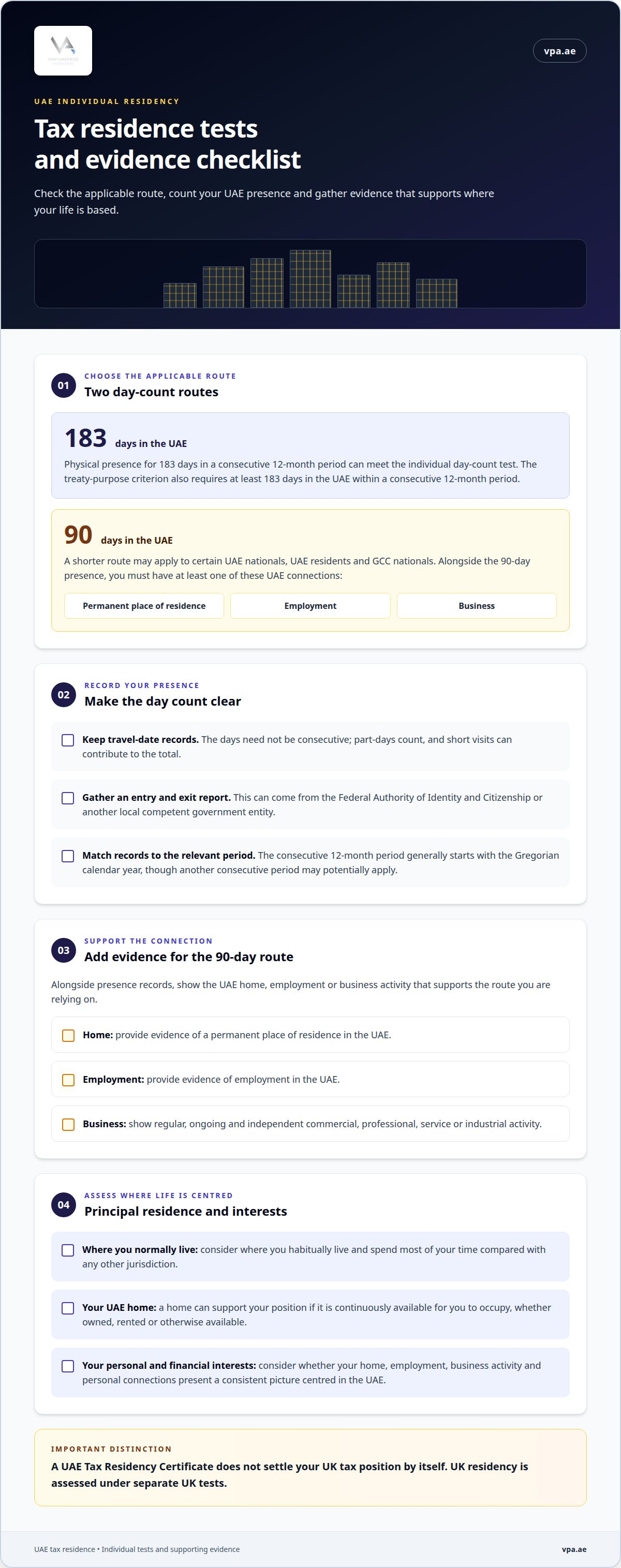
For individuals generally, 183 days of physical presence in the Emirates within a consecutive 12-month period meets the day-count test. Eligible UAE nationals, residents and GCC nationals can use the 90-day threshold when they satisfy the additional residence, employment or business condition. The days need not be consecutive, and part-days count. Short visits can contribute to the total, so maintain a record of travel dates.
Evidence can connect the test to your circumstances. An entry and exit report from the Federal Authority of Identity and Citizenship, or another local competent government entity, can document time in the jurisdiction. For a 90-day application, supporting material can also establish your UAE home, employment or business activity. Business includes regular, ongoing and independent commercial, professional, service or industrial activity.
To understand how to become a tax resident in the UAE, also consider when the relevant period allows you to apply. You can apply once you meet the applicable domestic or treaty criteria, including during the relevant tax period. The consecutive 12-month period generally starts with the Gregorian calendar year, though another consecutive period may potentially apply. A certificate cannot cover a future tax period that has not begun. Align your travel records and supporting documents before applying.
Principal residence and centre of financial and personal interests
Under Article 4 of the UAE Resolution, an individual can qualify through their usual or primary residence and centre of financial and personal interests in the UAE. This test looks beyond entry stamps: it asks where your life is genuinely based.
Your primary residence is generally where you habitually or normally live, and where you spend most of your time compared with any other jurisdiction. A UAE home can support this position if it is continuously available for you to occupy, whether owned, rented or otherwise available. Authorities may also consider where your personal and financial interests are centred. Your home, employment, business activity and personal connections should present a consistent picture.
Keeping a UK home or strong UK ties while claiming UAE residence can create competing residency claims. The UK may still consider you resident under its own tests, which examine factors such as your presence, available homes and work in the UK. A UAE tax residency certificate does not settle your UK tax position by itself; the applicable double taxation agreement may set out rules for resolving dual-residency cases.
For a certificate or claim involving a foreign tax authority, an international form may need attestation. Submit the completed form and pay the related fees. The Federal Tax Authority estimates 10 business days to process it after receiving the completed form and fees. It will not process a stamping request if the form has not been submitted or the application fee remains unpaid within 30 business days.
Keep a clear record of where you live and conduct your affairs. For example, organise UAE accommodation documents alongside employment or business records and evidence of personal and financial commitments. Compare these with your UK living arrangements and work pattern. This helps you assess whether the UAE is your principal residence, rather than relying on a certificate alone to show where your interests lie.
Evidence of UAE income, business or residence
A persuasive application connects your UAE status to evidence, not simply an assertion of residence. Match each document to the criterion you rely on: physical presence, a permanent home, or employment or business activity. For example, an applicant using the 90-day route needs evidence of UAE employment or business, or a permanent place of residence. Keep documents consistent with the period claimed.
Evidence of residence may include a title deed, certified tenancy contract (EJARI), another long-term rental contract or utility bills. These documents can help show that a home is available for you to occupy. Choose records that identify the UAE property and cover the relevant application period. A home document supports the residence criterion, but does not by itself establish every aspect of your tax status.
For presence, request an entry and exit report from the Federal Authority of Identity and Citizenship or another local competent government entity. Use it to evidence the days you spent in the UAE, then align its dates with the relevant consecutive 12-month period. For business, the UAE definition includes activity carried on regularly, on an ongoing basis and independently, including commercial, professional, service or industrial activity.
Residence: assemble the title deed, EJARI contract, long-term rental contract or utility bills that apply to your home.
Presence: use an official entry and exit report to support your day count.
Activity: organise evidence that demonstrates your employment or ongoing business activity.
For a natural person applying for a Tax Residency Certificate for double taxation agreement purposes, bank statements are no longer required. The Federal Tax Authority’s documentation standards still apply, so make sure each item relates to the test and period claimed. Clear, consistent records help demonstrate how your UAE presence, permanent residence or activity supports the status you seek.
Ventureprise Acquisitions: Setting Up A Company In Dubai: 6 Myths That Will Hold You Back
Ventureprise Acquisitions can help align your UAE business plans with the practical steps involved in establishing a commercial presence. If company formation is part of your wider move, its Company Formation and Strategic Planning offerings can support planning for your business structure and objectives.
Forming a company does not, by itself, establish your individual tax residency. You still need to meet the relevant UAE residency criteria and assemble evidence for the route you rely on. Ventureprise Acquisitions’ resource, Setting Up A Company In Dubai: 6 Myths That Will Hold You Back, can help you examine common assumptions before deciding how a Dubai company fits your plans.
For personal wealth considerations alongside a business move, explore whether private client wealth structuring is relevant to your wider objectives. Contact Ventureprise Acquisitions or visit vpa.ae to discuss your next steps.
Make your UAE plans work together
Tax residency is best considered as part of a wider personal and business strategy. Understanding how to become a tax resident in the UAE gives you a framework for assessing your position. The next step is to align that position with your plans for work, company formation and long-term wealth.
Ventureprise Acquisitions can support that planning through Company Formation and Strategic Planning. Its resource, Setting Up A Company In Dubai: 6 Myths That Will Hold You Back, can help you challenge assumptions as you consider establishing a commercial presence. Keep your residency evidence and business decisions connected, so each supports a coherent plan.
Use the criteria and documentation covered here to shape your next decisions. If you’re ready to explore how your UAE business plans fit together, contact Ventureprise Acquisitions to discuss your options. A clear strategy can help you move forward with purpose.
Frequently Asked Questions
What are the steps for switching your UK tax residency to Dubai tax residency?
Plan for both countries’ rules; UAE residency does not automatically end UK tax residency. Map your travel, home and work arrangements against the UK Statutory Residence Test, then assess the applicable UAE test and keep evidence for each position. The UK tax year runs from 6 April to 5 April, and HM Revenue & Customs treats at least 183 UK days in one tax year as an automatic residence test.
What requirements do you need to meet to become a Dubai tax resident?
You need to meet at least one applicable UAE individual residency criterion. The principal routes include physical presence for 183 days in a consecutive 12-month period, or 90 days for specified UAE nationals, UAE residents and GCC nationals who also meet a residence, employment or business condition. A certificate is a separate application: it documents qualifying status rather than creating it.
What are the UAE tax residency rules for individuals?
UAE Cabinet of Ministers Decision No. 85 of 2022 sets domestic criteria for individual tax residence. The rules assess physical presence, qualifying connections to the UAE, or a person’s usual residence and centre of personal and financial interests. Each day or part-day in the country counts towards day thresholds, and days need not be consecutive. An exceptional circumstance preventing planned departure may affect how days are treated.
What other tests determine UAE tax residency besides the 183-day rule?
Two key alternatives are the 90-day route for specified groups and the centre-of-life test. For the 90-day route, qualifying UAE nationals, UAE residents and GCC nationals also need a permanent UAE home, employment or a business there. The centre-of-life test considers whether your usual or primary residence and personal and financial interests are in the UAE, rather than relying only on travel totals.
How do you apply for a UAE tax residency certificate, and what documents are required?
Apply through the Federal Tax Authority portal once you meet the relevant domestic or treaty criteria. For a treaty-purpose application, an individual needs a passport; an entry and exit report can support presence, while a property document or employment evidence can support the relevant connection. Treaty applications by natural persons no longer require bank statements. Documentation must meet Ministerial Decision No. 27 of 2023.
What are the fees and processing times for a UAE tax residency certificate?
The Federal Tax Authority charges a submission fee, with a separate charge for each requested hard copy. It estimates 10 business days to process a completed application. A requested hard copy is estimated to take a further five business days after its fee is paid. These are separate processing stages, so include the hard-copy request and payment when planning for a physical certificate.



Comments